
As Web3 platforms mature, one challenge continues to slow adoption: payments.
Discovery, trading, messaging, freelancing, and on-chain data are all advancing rapidly — but without a reliable, integrated way to move value, platforms remain fragmented. Users are forced to rely on external wallets, manual transfers, and disconnected payment flows.
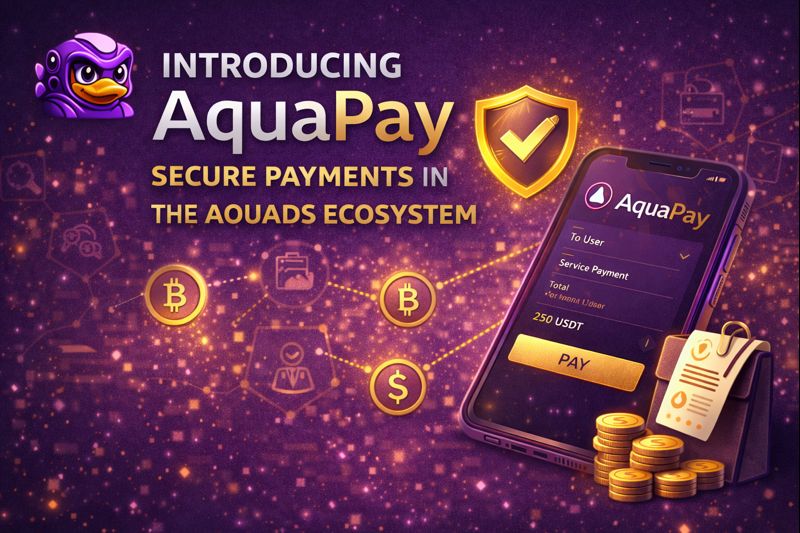
AquaPay was introduced to solve this problem inside Aquads.
This article explains:
What AquaPay is
Why it exists
How it fits into the Aquads platform
Who it’s built for
Why native payments are critical for Web3 adoption
What Is AquaPay?
AquaPay is Aquads’ native payment feature, designed to enable secure, streamlined crypto payments across the Aquads.xyz ecosystem.
Rather than acting as a standalone payment app, AquaPay is built as an internal value-transfer layer that supports transactions between users, services, and platform features.
Its purpose is simple:
Reduce friction when moving value inside Web3 applications.
AquaPay is designed to support use cases such as:
Paying for services
Platform-level transactions
Marketplace interactions
Future in-app payments across Aquads features
All without forcing users to leave the ecosystem or manage complex external flows.
Why AquaPay Matters
Web3 platforms often fail not because of technology — but because payments are clunky.
Common problems users face:
Manual wallet-to-wallet transfers
Copy-paste address errors
Lack of transaction context
No native settlement layer
Poor UX for non-technical users
AquaPay addresses these issues by embedding payments directly into the Aquads experience, aligning with the platform’s broader goal of making Web3 more usable, accessible, and business-ready.
AquaPay’s Role Inside Aquads
According to the Aquads whitepaper, the platform is designed as a bicentralized exchange and Web3 hub, combining:
Discovery tools
Advertising infrastructure
Freelance and service marketplaces
Messaging and booking systems
Trading and swap functionality
AquaPay fits into this vision as the transactional backbone.
Instead of payments being an afterthought, AquaPay allows value to move where activity already happens — inside chats, services, listings, and future platform modules.
This creates:
Less friction
Better user retention
More complete workflows
Fewer off-platform steps
Key Benefits of AquaPay
1. Native Payments (No Platform Hopping)
Users don’t need to leave Aquads to complete transactions. Payments are designed to be handled within the same environment where discovery, communication, and services take place.
This is critical for:
Freelancers
Clients
Projects
Platform-based interactions
2. Improved User Experience
By abstracting away unnecessary complexity, AquaPay helps:
Reduce user error
Lower onboarding friction
Improve trust between parties
This matters for onboarding users who are not crypto-native, but still want access to Web3 tools.
3. Platform-Level Trust & Accountability
Native payments allow Aquads to:
Associate transactions with platform activity
Improve dispute clarity
Build structured workflows around services and value exchange
This is especially important for marketplaces and service-based interactions.
4. Designed to Scale With the Ecosystem
AquaPay isn’t positioned as a one-off feature — it’s infrastructure.
As Aquads expands:
More features can plug into AquaPay
New payment-based workflows can be introduced
Additional settlement or payment logic can be layered in
This future-proofs the platform.
Who AquaPay Is Built For
AquaPay benefits multiple user types on Aquads:
🧑💻 Freelancers & Service Providers
Receive payments directly within the platform
Reduce manual wallet coordination
Streamline client workflows
🏗 Projects & Builders
Enable native transactions for services or tools
Reduce friction for users engaging with their offerings
🧑💼 Users & Clients
Pay for services without leaving the platform
Avoid address errors and manual steps
🌐 The Aquads Ecosystem Itself
Stronger user retention
More complete end-to-end workflows
Increased platform stickiness
Why Native Payments Are a Big Deal in Web3
Most Web3 platforms rely on external wallets alone — which works for power users, but not for scale.
Native payment layers:
Increase usability
Reduce mistakes
Improve trust
Enable new business models
AquaPay represents Aquads’ move toward infrastructure maturity, where the platform doesn’t just help users discover or trade — but actually transact.
Final Takeaway: AquaPay Completes the Stack
Aquads is positioning itself as more than a toolset — it’s building a full Web3 operating environment.
AquaPay is a critical piece of that puzzle.
By embedding payments directly into the platform:
Users move faster
Services become easier to deliver
Web3 workflows feel more natural
In the long run, platforms that control discovery and payments will win. AquaPay is Aquads taking that step.