From Meme Coins to Utility Tokens, DeFi Protocols, and Real-World Assets
Introduction
The on-chain project landscape has matured dramatically. What began as experimental token launches has evolved into a sophisticated ecosystem where meme coins, DeFi governance tokens, real-world asset (RWA) protocols, social tokens, and NFT-fi projects all compete for attention, liquidity, and community.
Every day, thousands of tokens are deployed across Solana, Ethereum, Base, BNB Chain, Sui, and emerging networks. Most never attract a community. Many receive only a handful of transactions before becoming inactive. Others fail because of poor planning, weak branding, regulatory missteps, or simply because the team underestimated the work required after deployment.
Launching a token is no longer just about deploying a smart contract.
In 2026, successful projects—whether meme coins or institutional-grade RWA platforms—combine branding, storytelling, community building, security, marketing, regulatory awareness, and long-term execution. The technical deployment is often the easiest part of the journey.
This guide was created to help founders, creators, developers, marketers, and entrepreneurs understand the complete process of launching an on-chain project—from the initial idea to building a thriving community after launch.
Meme coins remain the primary case study throughout this guide because they represent the most competitive, fastest-moving segment of the market. If you can launch a meme coin successfully, the same principles apply to utility tokens, DeFi protocols, and beyond—with additional layers of regulatory and technical complexity.
Whether you have a small budget or an experienced team, this playbook will help you avoid common mistakes and build a stronger foundation for your project.
Table of Contents
Token Taxonomy: Understanding What You're Building
Why Most On-Chain Projects Fail
Before You Create Anything
Choosing the Right Blockchain
Defining Your Project Vision
Building a Brand People Remember
The Legal & Regulatory Landscape in 2026
Tokenomics Explained
Technical Architecture & Token Standards
Building Your Website
Setting Up Your Social Channels
Growing Your Community
Preparing for Launch Day
Security Best Practices
Marketing Before and After Launch
Listings and Tracking Platforms
Scaling Your Project
Common Mistakes by Project Type
Frequently Asked Questions
Complete Launch Checklist
Chapter 1 — Token Taxonomy: Understanding What You're Building
Before writing a single line of code or designing a logo, you must answer a fundamental question: What kind of token are you building?
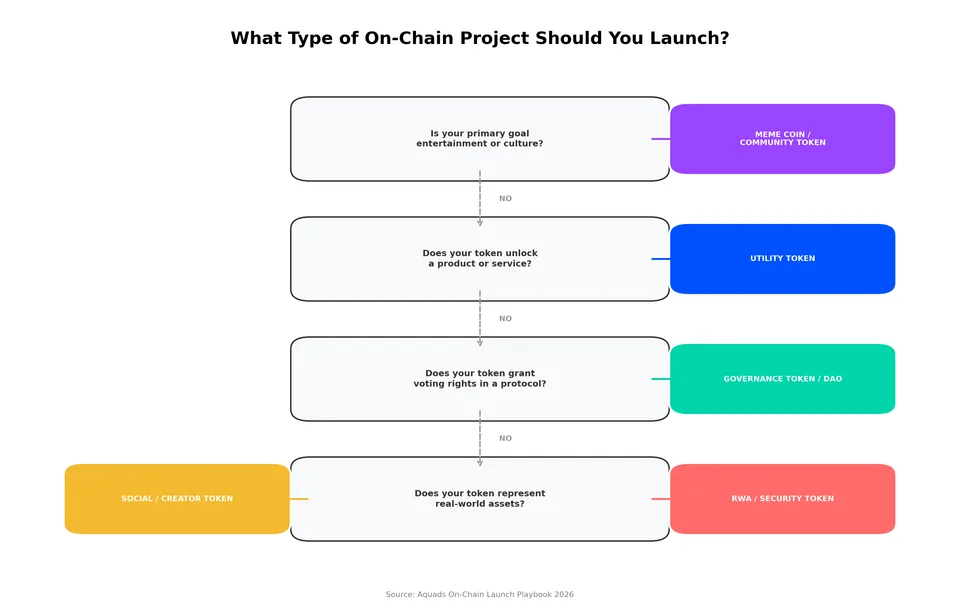
The type of project you launch determines your regulatory exposure, technical architecture, tokenomics design, marketing strategy, and community expectations. In 2026, the SEC and CFTC have formalized a five-category taxonomy that classifies every crypto asset by its characteristics, uses, and function. Understanding where your project fits is not optional—it shapes every decision that follows.
The Five Regulatory Categories
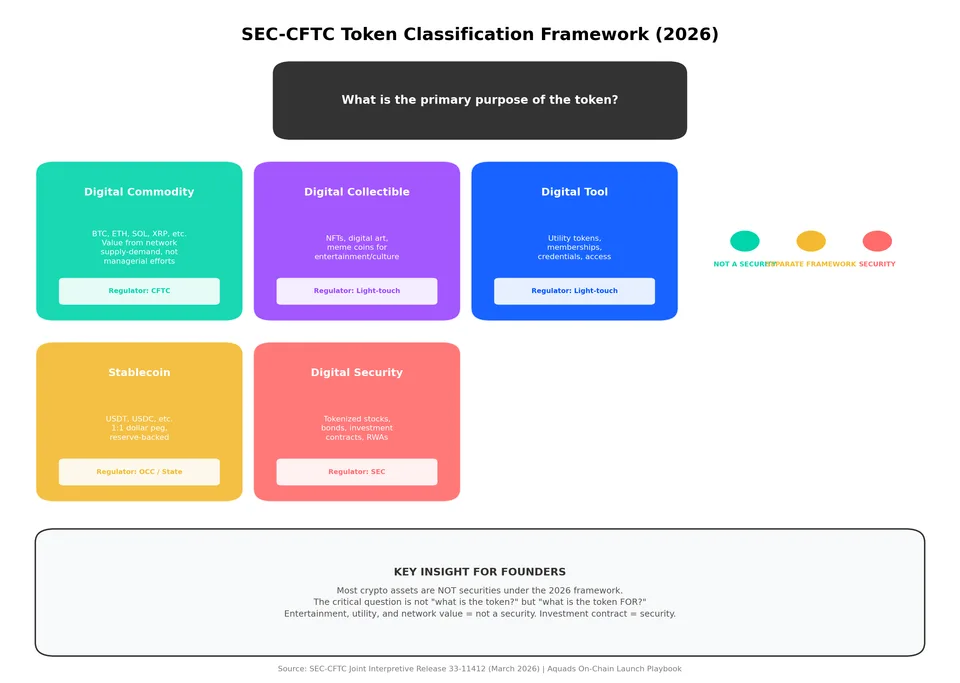
On March 17, 2026, the SEC and CFTC published a joint interpretive release (Release 33-11412) that sorts every crypto asset into one of five categories. Three are explicitly non-securities, one is governed by separate legislation, and only one remains under SEC jurisdiction.
Table
Category | What It Covers | Securities Status | Primary Regulator |
|---|---|---|---|
Digital Commodities | BTC, ETH, SOL, XRP, and 12 other named assets | Not securities | CFTC |
Digital Collectibles | NFTs, digital art, in-game items | Not securities | Light-touch |
Digital Tools | Utility tokens, memberships, credentials | Not securities | Light-touch |
Stablecoins | USD-pegged tokens (USDT, USDC) | Separate framework (GENIUS Act) | OCC / state regulators |
Digital Securities | Tokenized stocks, bonds, investment contracts | Securities | SEC |
The practical effect is immediate: the vast majority of crypto assets are formally not securities. For founders, this means clarity—but it also means choosing your project's category deliberately, because the boundaries matter.
The Six Project Types Founders Launch in 2026
1. Meme Coins / Community Tokens
·Purpose: Entertainment, cultural participation, community identity
·Regulatory category: Digital Collectible or Digital Tool (if structured correctly)
·Key characteristic: Value derives from community engagement and cultural resonance, not managerial efforts of a central team
·Examples: DOGE, PEPE, newer community-driven tokens
·Success factor: Storytelling, community energy, and cultural timing
2. Utility Tokens
·Purpose: Access to a product, service, or network function
·Regulatory category: Digital Tool
·Key characteristic: The token does something—grants access, pays for computation, unlocks features
·Examples: Chainlink (oracle services), Filecoin (storage), API keys
·Success factor: Real product-market fit and functional utility before token launch
3. Governance Tokens
·Purpose: Voting rights in a DAO or protocol
·Regulatory category: Digital Commodity (if sufficiently decentralized) or Digital Tool
·Key characteristic: Holders vote on protocol parameters, treasury allocation, and upgrades
·Examples: Uniswap (UNI), Aave (AAVE), Compound (COMP)
·Success factor: Active governance participation and clear decision-making scope
4. DeFi / Yield-Bearing Tokens
·Purpose: Revenue sharing, staking rewards, liquidity incentives
·Regulatory category: Can be Digital Tool or Digital Security depending on structure
·Key characteristic: Token captures value from protocol fees or economic activity
·Examples: Curve (CRV), Lido (LDO), liquidity provider tokens
·Success factor: Sustainable fee generation and clear value accrual mechanics
5. Real-World Asset (RWA) Tokens
·Purpose: Represent ownership of physical assets (real estate, commodities, credit)
·Regulatory category: Often Digital Securities or Commodity tokens depending on structure
·Key characteristic: On-chain representation of off-chain value with legal enforceability
·Examples: Tokenized real estate, gold-backed tokens, private credit vaults
·Success factor: Legal structure, custody, and regulatory compliance
6. Social / Creator Tokens
·Purpose: Monetize community, reward fans, align incentives between creators and audiences
·Regulatory category: Digital Collectible or Digital Tool
·Key characteristic: Tied to a person, brand, or community's economic activity
·Examples: Creator coins, fan tokens, community currencies
·Success factor: Authentic creator engagement and clear token utility
Why This Matters for Your Launch
A meme coin can launch with a $100 budget and a Twitter account. An RWA token needs legal counsel, custody arrangements, and regulatory filings. A DeFi governance token needs functional smart contracts, audit reports, and a working protocol before the token means anything.
Your project type determines:
·How much capital you need
·What legal risks you face
·Which blockchain makes sense
·What tokenomics model fits
·How you market and build community
·What "success" looks like
This guide uses meme coins as the primary case study because the principles of branding, community, and marketing are universal. But each chapter notes where utility, governance, RWA, and DeFi projects need additional considerations.
Chapter 2 — The Biggest Myth About Launching a Token
Many first-time founders believe this process looks like:
Create Token → Launch → People Buy → Price Goes Up → Success
Unfortunately, this almost never happens.
The reality is closer to this:
Idea → Research → Legal Review → Brand → Website → Social Media → Community Building → Marketing → Launch → Listings → Continuous Content → Community Management → Partnerships → Growth
The actual deployment of a token often takes less than an hour.
Building a successful project can take months or even years.
For RWA projects, add: legal structuring, custody setup, compliance review, and investor accreditation. For DeFi protocols, add: smart contract development, testnet deployment, bug bounties, and protocol audits. For meme coins, the timeline compresses—but the community-building phase is just as critical.
Chapter 3 — Why Most On-Chain Projects Fail
Understanding failure is just as important as understanding success.
1. No Story or Use Case
People don't invest in random tickers. They invest in stories or utility.
Ask yourself:
·Why should this project exist?
·What makes it different?
·Why would someone remember it tomorrow?
·What problem does it solve?
If your only answer is "because it will go to the moon," you're unlikely to build a lasting community. If you're building a utility token, the answer should be: "Because it makes X faster, cheaper, or possible in ways that weren't before."
2. Poor Branding
Many projects use:
·AI-generated logos with no personality
·Generic websites
·Inconsistent colors
·Weak messaging
Professional branding creates confidence. Visitors often decide within seconds whether a project feels trustworthy. This is true whether you're launching a meme coin or a $50M RWA fund.
3. No Community
Creating a Telegram or Discord server isn't enough.
Communities require:
·Daily conversations
·Moderation
·Announcements
·Events
·Giveaways
·Transparency
·Leadership
Without engagement, communities become inactive quickly. This applies to DAOs, DeFi protocols, and NFT projects just as much as meme coins.
4. Launching Too Early
Many founders rush deployment before they have:
·A website
·Social media accounts
·Graphics
·Moderators
·Marketing materials
·A roadmap
·Documentation
·(For utility/DeFi) Working product or testnet
Launching before these fundamentals are in place makes it much harder to build momentum. For DeFi projects, launching without a working protocol is catastrophic.
5. No Marketing Strategy
Many founders believe that launching automatically attracts attention.
In reality, every successful project invests significant effort into visibility. Marketing is an ongoing process that begins before launch and continues long after the token goes live.
6. Regulatory Blindness
Launching a token that looks like a security while claiming it's a utility is the fastest path to enforcement action. In 2026, with the SEC-CFTC taxonomy formalized, ignorance is no longer a defense.
Chapter 4 — Before You Spend Any Money
One of the smartest things you can do is validate your idea before paying deployment fees, purchasing domains, or commissioning artwork.
The Validation Checklist
Is the concept memorable? People should remember your project after hearing it once.
Does the name stand out? Avoid confusing spellings or names that closely resemble existing projects.
Is there room for a recognizable visual identity? Many successful projects are associated with a character, symbol, or design language that people instantly recognize.
Can the idea evolve? Projects that rely on a single joke or feature often struggle to maintain long-term interest. Instead, think about how your brand could expand into new products, integrations, or community initiatives over time.
For utility/DeFi projects, add:
·Have you identified a real problem that users face?
·Do you have evidence that people would pay for this solution?
·Is the token actually necessary, or could the product work without it?
Product-Market Fit Validation for Utility Projects
If you're building a utility or DeFi token, apply the Sean Ellis test: survey 40+ potential users with the question, "How disappointed would you be if you could no longer use this product?" If fewer than 40% answer "very disappointed," you don't have product-market fit yet.
Additional metrics to track:
·Customer retention: Are users still active after 30, 60, 90 days?
·Net Promoter Score (NPS): Would users recommend this to a friend? (Target: 50+)
·Core feature usage: Are users repeatedly engaging with the key functionality?
·LTV:CAC ratio: Is lifetime value at least 3x customer acquisition cost?
The "Would I Buy This?" Test
Be brutally honest with yourself. If you saw this project as an outsider, would you:
·Follow the social accounts?
·Join the community?
·Consider buying the token or using the product?
·Tell a friend about it?
If the answer to most of these is "no," your concept needs more work before you invest money into it.
Chapter 5 — Choosing the Right Blockchain
One of the first major decisions you'll make is selecting the blockchain where your token will launch.
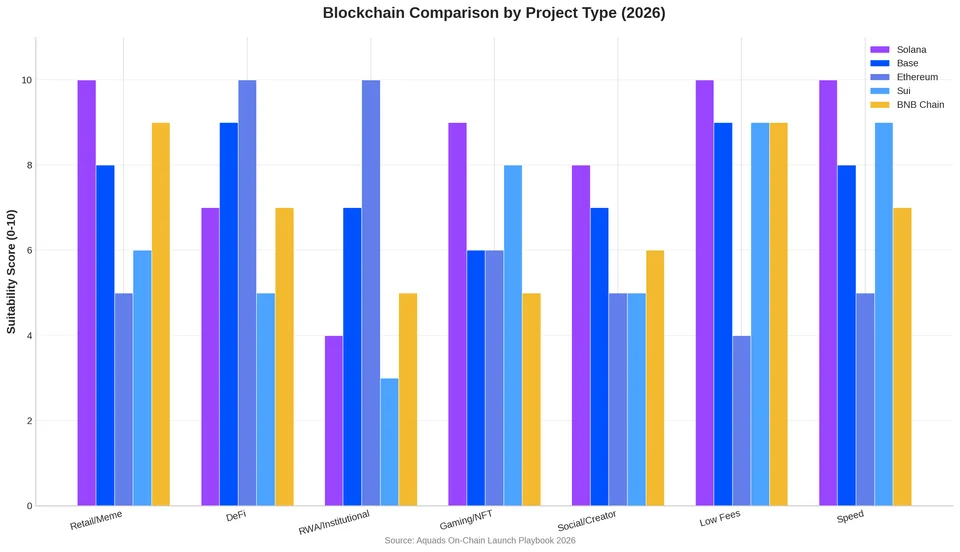
There is no universally "best" chain. Each ecosystem has its own strengths, costs, audience, and tooling. Your choice should align with your project type, goals, budget, and target community.
Solana
Best for: Meme coins, retail-facing projects, high-frequency trading, NFTs, gaming
Pros:
·Very low fees
·Mature meme coin ecosystem (Pump.fun, Jupiter Studio)
·Large retail user base
·Excellent wallet support (Phantom, Solflare, Backpack)
·High throughput (65,000+ TPS)
·Unified SPL token standard for fungible and non-fungible tokens
Potential considerations:
·High competition for attention
·Network outages historically (improving in 2026)
·Less institutional infrastructure than Ethereum
Base
Best for: Ethereum-aligned projects, DeFi protocols, consumer apps, Coinbase ecosystem integration
Pros:
·Low fees with Ethereum security guarantees
·Coinbase distribution and onboarding
·Growing developer ecosystem
·EVM compatibility (easy migration from Ethereum)
Potential considerations:
·Competition increasing rapidly
·Centralized sequencer (for now)
Ethereum
Best for: DeFi protocols, institutional projects, RWA tokens, high-security requirements
Pros:
·Largest DeFi ecosystem
·Strongest security history
·Extensive institutional infrastructure
·Most mature tooling and developer talent
·ERC-20, ERC-721, ERC-1155 standards with broad support
Potential considerations:
·Higher transaction costs (L2s mitigate this)
·Slower retail onboarding than Solana
Sui
Best for: Emerging ecosystem plays, gaming, projects seeking differentiation
Pros:
·High performance (parallel execution)
·Modern Move language (security-focused)
·Growing developer activity
·Less saturated than Solana or Base
Potential considerations:
·Smaller user base and liquidity
·Newer ecosystem requiring more education
BNB Chain
Best for: Global retail audiences, cost-conscious projects, fast deployments
Pros:
·Large user base (especially in Asia, Africa, LatAm)
·Low fees
·Mature ecosystem
·Broad exchange support
Potential considerations:
·Competitive launch environment
·Centralization concerns
How to Choose
Instead of asking: "What is the best blockchain?"
Ask: "Where is my audience already active, and what does my project type require?"
Project Type | Recommended Chains | Rationale |
|---|---|---|
Meme coin / community | Solana, Base, BNB Chain | Retail liquidity, low fees, viral potential |
DeFi / governance | Ethereum, Base, Arbitrum | Mature DeFi infra, institutional credibility |
RWA / institutional | Ethereum, Avalanche, Polygon | Compliance tools, custody, legal frameworks |
Gaming / NFTs | Solana, Sui, Immutable X | Throughput, low-cost NFTs, gamer audience |
Social / creator | Solana, Base, Lens (Polygon) | Low-cost social transactions, creator tooling |
Chapter 6 — Defining Your Project Vision
Before you create a single graphic or write a single tweet, you need clarity on what your project stands for.
The Vision Framework
A strong project vision answers three questions:
1.What is this project about? (The core concept or problem)
2.Who is it for? (The target audience)
3.Why should anyone care? (The emotional or functional hook)
Example: Strong vs. Weak Vision
Weak (Meme): "We're launching a dog coin because dog coins do well."
Strong (Meme): "We're creating a community-driven project that celebrates the underdog spirit. Every holder is part of a movement that proves small communities can achieve big things."
Weak (Utility): "We're a DeFi protocol with a token."
Strong (Utility): "We're building the most capital-efficient lending protocol for NFTs, enabling holders to borrow against their assets without selling them."
Writing Your Project Narrative
Your narrative should be:
·Simple — Explainable in one sentence
·Relatable — Taps into emotions or experiences people understand
·Expandable — Can grow into new content, products, and initiatives
·Authentic — Feels genuine, not manufactured
For utility and DeFi projects, add:
·Measurable — What metric will you improve? (Cost, speed, accessibility)
·Differentiated — Why can't incumbents do this easily?
·Defensible — What moat will you build over time?
Spend time on this. A weak narrative is the fastest way to a failed launch.
Chapter 7 — Building a Brand People Remember
In a market where thousands of tokens launch weekly, brand is your competitive advantage.
The Elements of a Strong On-Chain Brand
1. Name
·Easy to spell and pronounce
·Memorable after one mention
·Not easily confused with existing projects
·Works as a hashtag and social handle
·Available as a domain and across platforms
2. Visual Identity
·A distinctive mascot or symbol (for community projects)
·A clean, professional mark (for institutional projects)
·Consistent color palette (2-3 primary colors)
·Logo that works at small sizes (Twitter profile, Telegram icon)
·Meme templates or visual assets the community can use
3. Tone of Voice
·How does your project "speak" on social media?
·Is it playful? Serious? Technical? Educational?
·Consistency across all channels builds recognition
·For RWA/institutional projects: professional, compliant, reassuring
4. Brand Guidelines Even for small projects, a simple one-page guide helps:
·Approved colors and fonts
·Logo usage rules
·Tone examples
·What NOT to say or do (especially important for regulated projects)
Real-World Examples
·Dogecoin — The Shiba Inu visual is instantly recognizable worldwide
·Uniswap — The unicorn mark is playful but professional, matching its DeFi positioning
·Chainlink — The cube logo conveys technical infrastructure and reliability
·PEPE — The frog character was already cultural before crypto; the project amplified it
The strongest brands build visual identities that survive being separated from the project name. Generic logos and clichéd mascots fail this test; original, repeatable visual hooks pass it.
Budgeting for Design
Budget Level | What You Can Afford | Expected Quality |
|---|---|---|
$0–$100 | DIY with Canva, AI tools, free templates | Basic, functional |
$100–$500 | Freelance designer (Fiverr, Aquads,Upwork) | Professional, custom |
$500–$2,000 | Experienced crypto designer | Polished, brand-ready |
$2,000–$10,000 | Design agency or studio | Premium, comprehensive |
$10,000+ | Top-tier branding agency | Enterprise-grade identity |
Pro tip: Even with a small budget, prioritize your logo and a few key social assets. First impressions matter enormously in crypto. For RWA and institutional projects, professional design is non-negotiable.
Chapter 8 — The Legal & Regulatory Landscape in 2026
In 2026, regulatory clarity has arrived—but with it comes responsibility. The SEC-CFTC joint interpretive release of March 2026 created a formal taxonomy, but founders must still navigate carefully.
The SEC-CFTC Five-Category Framework
Digital Commodities (Not Securities) Assets whose value stems from a functional blockchain network and market supply-demand, not from managerial efforts. The SEC named 16 specific assets: BTC, ETH, SOL, XRP, ADA, AVAX, LINK, DOT, ATOM, ALGO, NEAR, UNI, FIL, HBAR, XLM, and APT.
For founders: if your token operates on a mature, decentralized network and derives value from network usage rather than your team's efforts, it may qualify as a digital commodity.
Digital Collectibles (Not Securities) NFTs, digital art, in-game items, and tokenized representations of memes or cultural moments. These are explicitly non-securities when sold as individual collectible items.
Digital Tools (Not Securities) Utility tokens, memberships, credentials, and title instruments. These serve a functional purpose and are not securities if structured correctly.
Stablecoins (Separate Framework) Governed by the GENIUS Act (signed July 2025). Payment stablecoins that maintain 1:1 dollar pegs, hold reserves in USD or short-term Treasuries, and submit to monthly audited reserve reports are excluded from securities definitions entirely.
Digital Securities (SEC Jurisdiction) Tokenized stocks, bonds, notes, and any crypto asset functioning as an investment contract. Putting a security on a blockchain does not change its economic substance.
Critical Distinction: The Howey Test Still Applies
The SEC-CFTC framework does not eliminate the Howey Test. It provides categories, but individual tokens are still evaluated case-by-case. The test asks: Is there an investment of money in a common enterprise with an expectation of profits derived from the efforts of others?
Red flags that push a token toward securities classification:
·Promises of financial returns or profit sharing
·Centralized team control over token value
·Marketing that emphasizes price appreciation
·Revenue-sharing or dividend-like distributions tied to managerial efforts
Green flags for non-securities status:
·Token serves a functional, consumptive purpose
·Network is sufficiently decentralized
·No promises of returns from the team's efforts
·Value derives from user adoption and network effects, not managerial execution
The Transition Mechanism
One of the most significant features of the 2026 framework is that tokens can change categories over time. A token that started as a security can cease to be one when the issuer fulfills its promises or the project reaches sufficient decentralization. This gives utility and governance projects a defined path from SEC oversight to commodity status.
MiCA and Global Regulation
For projects targeting EU users, the Markets in Crypto-Assets (MiCA) regulation is fully applicable as of December 2024. MiCA requires:
·Registration with national competent authorities
·White paper publication for crypto-asset offerings
·Robust risk management and AML procedures
·Compliance reporting and audits
·Passport rights across EU member states (once authorized)
Key MiCA categories:
·Asset-Referenced Tokens (ARTs): Tokens referencing multiple assets or commodities
·E-Money Tokens: Tokens referencing a single official currency
·Other Crypto-Assets: Everything else (including most utility and meme tokens)
Practical Compliance Checklist
For all projects:
·[ ] Do not promise financial returns or investment profits in marketing
·[ ] Be transparent about the token's purpose (entertainment, utility, governance)
·[ ] Avoid misleading marketing about price appreciation
·[ ] Document the token's functional purpose (even for meme coins: cultural participation)
·[ ] Consider consulting a crypto-savvy attorney in your jurisdiction
For utility/governance projects:
·[ ] Ensure the token has a genuine, non-speculative use case at launch
·[ ] Document network decentralization milestones
·[ ] Avoid language that frames the token as an investment
·[ ] Consider KYC/AML procedures if raising significant capital
For RWA/security tokens:
·[ ] Engage securities counsel immediately
·[ ] Determine applicable exemptions (Reg D, Reg S, etc. in the US)
·[ ] Implement investor accreditation checks
·[ ] Prepare full disclosure documentation
·[ ] Register or qualify as required in target jurisdictions
For EU-targeted projects:
·[ ] Prepare a MiCA-compliant white paper
·[ ] Register with relevant national competent authority
·[ ] Implement AML/KYC procedures
·[ ] Ensure marketing communications meet MiCA standards
The "Entertainment Purpose" Safe Harbor for Meme Coins
The SEC's February 2025 staff statement clarified that meme coins purchased for entertainment or cultural purposes typically do not involve securities offerings. However, this protection evaporates if:
·The token is marketed with profit promises
·The team controls token value through managerial efforts
·The offering resembles an investment contract
Bottom line: Even meme coins must be honest about what they are.
Chapter 9 — Tokenomics Explained
Tokenomics (token economics) determines how your token is distributed, how it behaves, and how holders are incentivized. The right tokenomics model depends entirely on your project type.
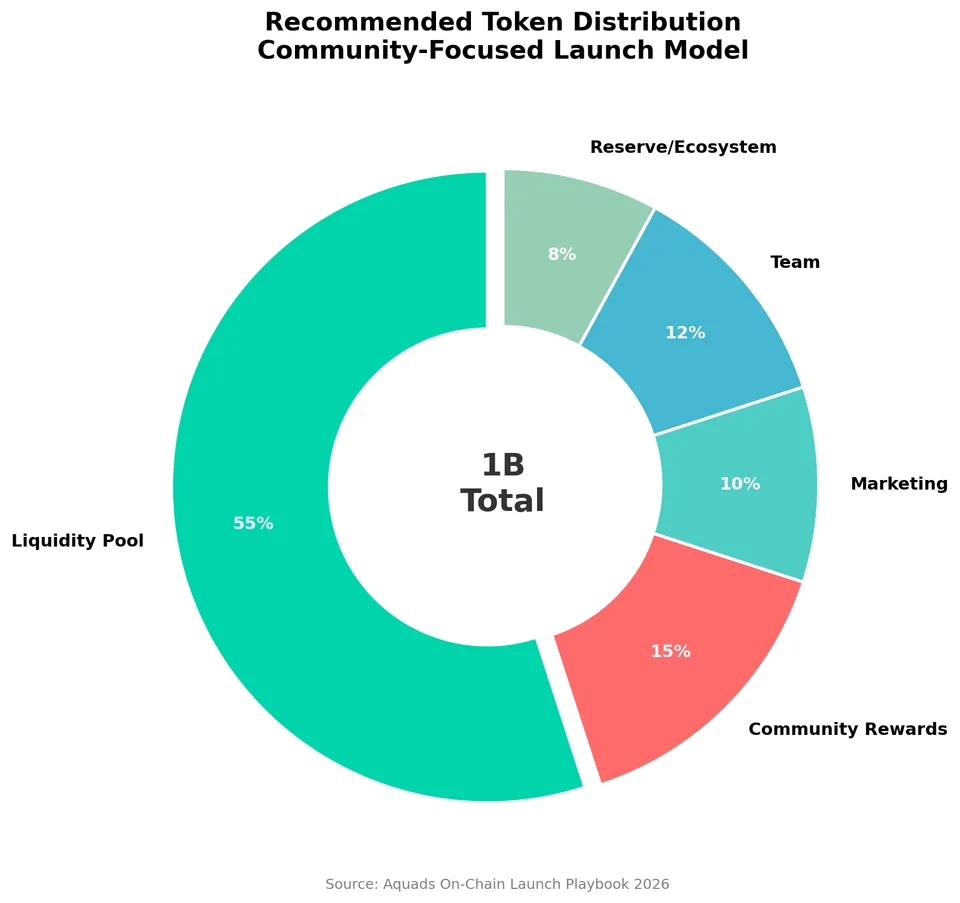
Tokenomics by Project Type
Meme Coins / Community Tokens
·Supply: Fixed supply is most common (e.g., 1 billion tokens, no more ever created)
·Distribution: 50–80% to liquidity, 5–15% team, 5–10% marketing, 5–15% community rewards
·Taxes: Optional (0–10% total). Reflections, liquidity addition, burn, or marketing wallet
·Key principle: Simplicity and fairness. Complex tokenomics confuse retail investors.
Utility Tokens
·Supply: Fixed or carefully managed inflation
·Distribution: Must balance early adopters, team, ecosystem growth, and public access
·Key principle: The token must be necessary for the product to function. If the product works without the token, the token has no economic basis.
·Vesting: Team and investor tokens should have cliffs (6–12 months) and linear vesting (2–4 years)
Governance Tokens
·Supply: Often inflationary to reward ongoing participation
·Distribution: Community-heavy. Uniswap's airdrop to early users is the gold standard.
·Key principle: Voting power should align with long-term commitment, not just wealth. Consider vote-locking or delegation mechanisms.
·Vesting: Governance tokens released too quickly create short-term selling pressure. Time-weighted distribution rewards sustained participation.
DeFi / Yield Tokens
·Supply: Often inflationary to bootstrap liquidity, transitioning to fee-based sustainability
·Distribution: Liquidity providers, stakers, team, treasury, community
·Key principle: Emissions must eventually be replaced by real protocol revenue. "Real yield" from fees is more sustainable than token emissions.
·Hybrid models: Combine base emissions with fee capture. As protocol matures, shift from emissions to fee-based rewards.
RWA Tokens
·Supply: Tied to underlying asset (e.g., 1 token = 1 gram of gold, or $1 of real estate equity)
·Distribution: Often sold to accredited/institutional investors initially
·Key principle: Transparency of reserves, redemption rights, and legal enforceability
·Compliance: Must document asset backing, custody arrangements, and audit procedures
Core Supply Models
Fixed Supply (Immutable)
·No new tokens can ever be created
·Supply can only decrease through burning
·Best for: Revenue-generating protocols, meme coins, scarcity-driven projects
·Risk: No mechanism to bootstrap participation if revenue is low early
Inflationary (Emissions)
·New tokens minted as rewards for staking, liquidity provision, or participation
·Best for: Bootstrapping network effects, governance participation, early ecosystems
·Risk: Permanent inflation without fee transition destroys holder value
Deflationary (Burn Mechanisms)
·Tokens permanently removed from circulation
·Can be automatic (transaction-based) or governance-driven (buyback-and-burn)
·Best for: Offsetting emissions, creating scarcity signals
·Risk: Burning without revenue is theater; burning funded by real fees converts economic value into scarcity
Hybrid (Emissions + Fee Capture)
·Start with emissions to bootstrap, transition to fee-based sustainability
·Best for: Most DeFi protocols with clear path to revenue
·Risk: Complexity. Every additional mechanism adds governance burden.
Distribution Best Practices
Vesting as Mechanism Design Vesting is not just "investor optics"—it is a control system for supply shocks. Best practices include:
·Cliff: 6–12 months before any tokens unlock (prevents immediate dumping)
·Linear vesting: Smooth, predictable unlock schedule
·Transparent schedules: Public dashboards reduce governance friction
·Immutable terms: If governance can arbitrarily change vesting, vesting loses credibility
Airdrops: Community or Sell Pressure? Airdrops can distribute ownership to real users and create durable governance participation. They can also become short-term liquidity extraction events. Good airdrop design answers:
·Why are these recipients strategically valuable long term?
·What behavior should the airdrop reinforce?
·Do recipients have a reason to hold, stake, or use the token after claiming?
Tokenomics Red Flags
·Massive team allocation (over 20%)
·No liquidity lock
·Hidden mint functions
·Blacklist features that can freeze wallets
·Ability to change taxes after launch
·Governance that can arbitrarily alter supply
·No clear path from emissions to sustainability (for DeFi)
Chapter 10 — Technical Architecture & Token Standards
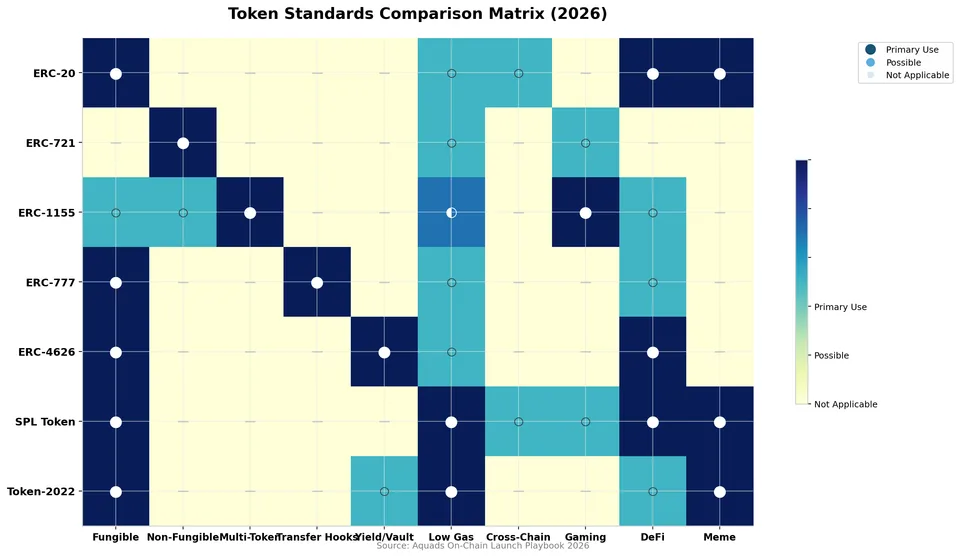
Your choice of token standard and technical architecture shapes security, interoperability, gas costs, and what your token can actually do. In 2026, the landscape has expanded beyond basic ERC-20 tokens.
Token Standards by Ecosystem
Ethereum & EVM Chains (Base, BNB Chain, Avalanche, Arbitrum)
Standard | Type | Best For | Key Features |
|---|---|---|---|
ERC-20 | Fungible | Utility tokens, governance, meme coins | Simple, universal, broad wallet support |
ERC-721 | Non-fungible | Digital art, collectibles, unique assets | Strict uniqueness, provenance tracking |
ERC-1155 | Multi-token | Gaming, marketplaces, hybrid economies | Batch transfers, fungible + NFT in one contract, lower gas |
ERC-4626 | Tokenized vault | Yield-bearing tokens, DeFi vaults | Standardized deposit/withdrawal, share calculation |
ERC-777 | Advanced fungible | Tokens needing hooks/callbacks | Enhanced transfer functionality |
Solana Table
Standard | Type | Best For | Key Features |
|---|---|---|---|
SPL Token | Fungible | All fungible tokens on Solana | Unified standard, low cost, high speed |
Token-2022 | Enhanced fungible | Interest-bearing, transfer fees, confidential transfers | New minting functions, enhanced capabilities |
Metaplex | NFT | Digital collectibles, gaming assets | Rich metadata, candy machine launches |
Key Architectural Difference: Ethereum uses a "deploy new contract for each token" model (code-centric). Solana uses a "reuse one universal program, new tokens are data accounts" model (data-centric). This makes Solana token creation cheaper and faster but requires different mental models for developers.
Choosing the Right Standard
For meme coins / community tokens:
·ERC-20 (EVM chains) or SPL Token (Solana)
·Simplest, cheapest, most supported
·Avoid complex tax mechanisms unless necessary
For utility tokens:
·ERC-20 or SPL Token for basic utility
·Token-2022 (Solana) if you need transfer fees, interest-bearing features, or confidential transfers
·ERC-777 if you need advanced transfer hooks
For NFT collections:
·ERC-721 for unique, high-value art/collectibles
·ERC-1155 for gaming assets, multi-edition drops, or economies with both fungible and non-fungible items
For DeFi / yield-bearing:
·ERC-4626 for vaults and yield-bearing tokens
·Custom contracts for complex staking, lending, or derivatives
For RWA / security tokens:
·ERC-1400 or ERC-3643 (security token standards with compliance controls)
·ERC-20 with transfer restrictions and whitelisting
·Custom legal wrappers
Smart Contract Complexity by Project Type
Project Type | Contract Complexity | Audit Criticality | Typical Development Time |
|---|---|---|---|
Meme coin (basic ERC-20) | Low | Medium | 1–7 days |
Meme coin (with taxes/burn) | Medium | High | 1–2 weeks |
Utility token (basic) | Low | Medium | 1–7 days |
Governance token (with voting) | Medium | High | 2–4 weeks |
DeFi protocol (staking/lending) | High | Critical | 1–3 months |
RWA token (with compliance) | High | Critical | 2–6 months |
NFT collection (ERC-721/1155) | Medium | High | 2–4 weeks |
Game economy (multi-token) | Very High | Critical | 3–6 months |
Development Approach
No-Code / Low-Code Options:
·Token Generator (ERC-20, ERC-721, ERC-1155 deployment without coding)
·Pump.fun (Solana meme coins)
·Four.meme (BNB Chain meme coins)
·Jupiter Studio/Raydium Launch Labs (Solana token creation)
·Thirdweb (Multi-chain contract deployment)
Custom Development:
·Hire Solidity or Rust developers
·Use OpenZeppelin libraries (Ethereum) or Anchor framework (Solana)
·Budget $3,000–$50,000+ depending on complexity
For DeFi/RWA projects:
·Custom development is mandatory
·Budget for multiple audits ($10,000–$100,000+)
·Plan for testnet deployment and bug bounties
Chapter 11 — Building Your Website
Your website is often the first place potential investors, users, or partners go to research your project. In 2026, over 60% of all crypto-related activities occur on mobile devices, and users' perceptions of credibility depend heavily on website design.
What Your Website Needs
Essential Pages:
1.Homepage
Clear project name and logo
One-sentence description
Links to buy/trade/use the token
Social media links
Contract address (prominently displayed)
2.About / Story
The origin story
What makes the project unique
The vision for the future
Team bios (if not anonymous)
3.Tokenomics
Supply details
Distribution breakdown (with visual chart)
Tax structure (if any)
Vesting schedules (if applicable)
For DeFi: fee structure and value accrual
4.Roadmap
What you've already done
What's coming next (with realistic timelines)
Be realistic — overpromising destroys trust
How to Buy / Use
Step-by-step guide for beginners
Wallet recommendations
Exchange/ DEX links
Video tutorial (if possible)
For utility: how to use the product
6.Documentation / Whitepaper
Technical architecture overview
Token standard used
Smart contract addresses (verified)
For DeFi: protocol mechanics, risk parameters
For RWA: legal structure, custody details, audit reports
Community / Social Links
Twitter/X, Telegram, Discord, Reddit, GitHub
Website Builders for Crypto Projects
·Nicepage / Webflow — Professional-grade with crypto-specific templates
·Wix / Squarespace — Simple, fast, good for basic landing pages
·Carrd — Extremely fast, single-page sites, perfect for MVP launches
·GitBook / ReadMe — Excellent for documentation and whitepapers
·Custom development — For projects with larger budgets and complex needs
Quick Website Checklist
·[ ] Loads in under 3 seconds
·[ ] Works perfectly on mobile
·[ ] Contract address is easy to find and copy
·[ ] All links work
·[ ] Social links are prominent
·[ ] No broken images or placeholder text
·[ ] SSL certificate installed (HTTPS)
·[ ] For regulated projects: legal disclaimers, risk warnings, jurisdiction notices
Chapter 12 — Setting Up Your Social Channels
Social media is where your community lives. In 2026, the platform landscape has evolved, but the fundamentals remain the same.
Platform Priority by Project Type
All Projects (Essential):
1. Twitter / X
·The primary platform for crypto discourse
·Where news breaks, narratives form, and communities gather
Best practices:
·Post 3–5 times daily during pre-launch and launch phases
·Use threads to tell stories and explain complex concepts
·Engage with other projects and influencers
·Use relevant hashtags (#Web3 #DeFi #NFT #memecoin)
·Pin your most important tweet (contract address, website, how to buy)
·For utility/DeFi: share development updates, governance proposals, protocol metrics
2. Telegram (Essential)
·Real-time chat with your community
·Best for announcements, Q&A, and building intimacy
Setup tips:
·Create a group (not just a channel) for two-way conversation
·Add moderation bots (Rose, Combot, Shieldy) for spam control
·Have at least 2–3 active moderators before launch
·Create a welcome message with key links and FAQ
3. Discord (Recommended for complex projects)
·Better for organized communities with multiple topics
·Good for NFT projects, games, DAOs, or DeFi protocols with governance
Setup tips:
·Organize channels clearly (announcements, general, support, governance, development)
·Use roles to reward active members and distinguish contributors
·Consider voice channels for AMAs and governance calls
4. GitHub (Essential for utility/DeFi)
·Open-source code builds trust
·Document your smart contracts, frontend, and protocol logic
·Active development history signals a serious team
Growing in Importance:
5. TikTok / YouTube Shorts
·Short-form video is now the default channel for reaching retail audiences
·Can launch a project into virality overnight
·Best for memes, explainer clips, and community highlights
6. Reddit
·r/cryptocurrency, r/DeFi, r/NFT, chain-specific subreddits
·Organic discussion and ground-level marketing
·AMAs can drive significant engagement
7. LinkedIn (For RWA / institutional)
·Professional audience, investor relations
·Share regulatory updates, partnership announcements, thought leadership
The Pre-Launch Social Strategy
8–12 weeks before launch:
·Create accounts on all platforms
·Begin posting consistently (even if audience is small)
·Share behind-the-scenes content
·Build anticipation with teasers
·Engage with existing communities
·For utility/DeFi: publish technical blog posts, explainers, and research
4–6 weeks before launch:
·Increase posting frequency
·Start countdown content
·Release branding and mascot
·Begin influencer outreach
·Launch community events or contests
·For DeFi: launch testnet, invite beta users, publish audit reports
1–2 weeks before launch:
·Daily content
·Coordinate with influencers for launch day
·Finalize all creative assets
·Prepare launch day timeline
·Ensure all moderators are trained and ready
·For regulated projects: ensure all marketing complies with jurisdiction requirements
Chapter 13 — Growing Your Community
Community is the single most important factor in on-chain project success. An active community generates excitement, market volume, partnerships, and brings in referrals.
Community Growth Tactics That Work in 2026
1. Airdrops and Giveaways
·Distribute small amounts of tokens to early supporters
·Require social engagement (follow, retweet, join Telegram)
·Use tiers: basic participants get small rewards, high-value contributors get more
·Critical: Use filters to avoid bots — wallet age, real product use, community contribution
·For DeFi: airdrop to testnet users, early liquidity providers, or governance participants
2. Meme Contests / Content Challenges
·Encourage community-created content
·Offer token prizes for the best submissions
·Feature winning entries on official channels
·Creates a library of shareable content
·For utility projects: technical tutorials, integration showcases, use-case stories
3. AMAs (Ask Me Anything)
·Regular sessions with the team
·Builds transparency and trust
·Can be hosted on Twitter Spaces, Telegram, or Discord
·Record and share highlights
·For RWA/institutional: investor calls, regulatory updates, quarterly reviews
4. Referral Programs
·Reward users for bringing in active new members
·Tie rewards to real engagement, not just sign-ups
·Better reward actions: completed onboarding, first trade, repeated weekly activity
5. Shilling and Raids (Community-Driven)
·Organized community efforts to promote the project on social media
·Coordinate comments on influencer posts
·Activity across crypto forums and Twitter threads
·Warning: Professional shilling services exist, but organic community-driven efforts are more authentic and sustainable
6. Governance Participation (For DAOs/Governance Tokens)
·Incentivize voting and proposal creation
·Recognize active governance participants
·Publish governance summaries and outcomes
·Make governance accessible, not intimidating
Community Management Best Practices
·Be present daily — Silence kills communities
·Answer questions quickly — Even simple ones
·Ban spammers immediately — One spammer can ruin the vibe
·Celebrate milestones — Holder counts, volume records, exchange listings, governance votes
·Be transparent about problems — Delays, bugs, market dips — address them head-on
·Create inside jokes — Shared language builds identity
·Recognize top contributors — Special roles, shoutouts, rewards
·For DeFi/DAO: Publish regular protocol updates, risk metrics, and treasury reports
Chapter 14 — Preparing for Launch Day
Launch day is where preparation meets opportunity. The first 24–48 hours often determine whether a project gains traction or fades into obscurity.
The Launch Day Timeline
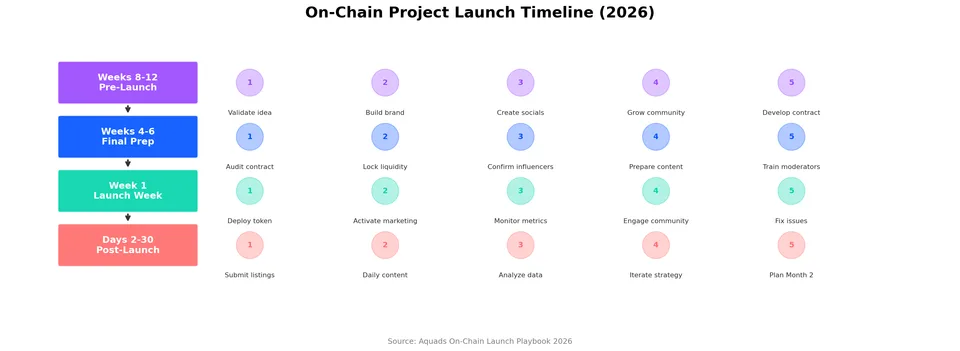
T-Minus 2 Weeks:
·Finalize all smart contracts
·Complete security audit
·Lock liquidity (for DEX launches)
·Prepare all marketing materials
·Confirm influencer partnerships
·Train moderators
·Test all links and platforms
·For utility/DeFi: ensure testnet is live and functional, invite beta testers
·For RWA: confirm legal documentation, custody arrangements, and compliance checks
T-Minus 24 Hours:
·Announce launch time across all channels
·Ensure website is live and functional
·Verify contract address is correct everywhere
·Prepare pinned tweets and announcements
·Brief all team members on their roles
·Set up monitoring for price, volume, and social mentions
·For regulated projects: ensure all marketing materials are compliant
Launch Hour (T-0):
·Deploy token / create liquidity pool / open product access
·Post contract address simultaneously across all channels
·Pin contract address tweet
·Activate influencer partnerships
·Begin community raids and shilling
·Monitor for technical issues
·Be present in all community channels
·For DeFi: monitor protocol metrics, ensure oracles and price feeds are functional
T+1 to T+24 Hours:
·Continuous engagement on social media
·Answer all questions in community channels
·Share volume and holder milestones
·Address any technical issues immediately
·Keep energy high — this is when most people are watching
·For utility: onboard first users, collect feedback, fix bugs rapidly
T+2 to T+7 Days:
·Submit listing applications to CoinGecko and CoinMarketCap
·Continue marketing push
·Begin planning post-launch content calendar
·Analyze what worked and what didn't
·Start planning next phase of growth
·For DeFi: monitor protocol health, liquidity depth, and user retention
Launch Methods: Your Options
1. Fair Launch (Bonding Curve)
·Platforms: Pump.fun (Solana), Four.meme (BNB Chain), similar mechanisms on other chains
·Everyone buys in at the same price initially; price rises as more people buy
·When market cap hits a threshold, liquidity automatically moves to a DEX
·Pros: Simple, transparent, no presale advantages, strong community trust
·Cons: High competition, many launches fail to graduate, limited capital raised
·Best for: Meme coins, community tokens, projects that don't need upfront capital
2. Direct DEX Launch
·Create liquidity pool directly on Uniswap, PancakeSwap, Raydium, Jupiter, etc.
·You control the initial price and liquidity
·Pros: Full control over launch parameters, immediate DEX trading
·Cons: Requires more technical knowledge, need to attract initial buyers, capital required for liquidity
·Best for: Projects with existing community, utility tokens, DeFi protocols
3. Presale / IDO (Initial DEX Offering)
·Sell tokens to early investors before public trading
·Platforms: PinkSale, DxSale, Polkastarter, DAO Maker
·Pros: Raises capital for marketing and development, rewards early believers
·Cons: Creates sell pressure at launch if not structured carefully, regulatory scrutiny
·Best for: Projects needing startup capital, utility tokens with working products
4. Launchpad / IEO
·Platforms: Binance Launchpad, KuCoin Spotlight, Bybit Launchpad
·Pros: Access to large user bases, credibility boost, marketing support
·Cons: Strict requirements, approval process, often requires KYC, platform fees
·Best for: High-quality projects with strong teams, significant marketing budgets
5. VC / Angel Round + Public Launch
·Raise from venture capitalists or angel investors before public launch
·Pros: Significant capital, mentorship, network access, credibility
·Cons: Dilution, potential misalignment with community interests, longer timeline
·Best for: DeFi protocols, infrastructure projects, RWA tokens needing legal/compliance capital
6. Community Sale / Fair Launch with Vesting
·Sell to community members at a fixed price with lock-up periods
·Pros: Aligns early holders with long-term success, reduces dump risk
·Cons: Complex to manage, requires KYC infrastructure
·Best for: DAOs, governance tokens, projects prioritizing community ownership
Fundraising Model Selection by Project Type
Project Type | Recommended Launch Method | Capital Needed |
|---|---|---|
Meme coin | Fair launch (Pump.fun) or direct DEX | $100–$2,000 |
Community/social | Fair launch or community sale | $500–$5,000 |
Utility (basic) | Direct DEX or small presale | $2,000–$20,000 |
DeFi protocol | Presale/IDO + direct DEX, or VC round | $10,000–$100,000 |
Governance/DAO | Community sale + airdrop | $100,000–$1M+ |
RWA/Security | VC round + regulated offering | $5,000–$50,000 |
NFT collection | Direct mint or launchpad | $100,000–$1M+ |
The First 48 Hours Are Critical
Data from 2026 shows that projects generating strong momentum in the first 48 hours are significantly more likely to sustain growth. Create FOMO by showing early adoption and excitement — but never fake it. Authentic excitement is detectable; manufactured hype is obvious and damaging.
For utility and DeFi projects, the first 48 hours are about user onboarding and product stability, not just price action. A working product with happy early users generates more long-term value than a pump without substance.
Chapter 15 — Security Best Practices
Security failures destroy projects and reputations. In 2026, with industrialized scam playbooks, security is non-negotiable regardless of project type.
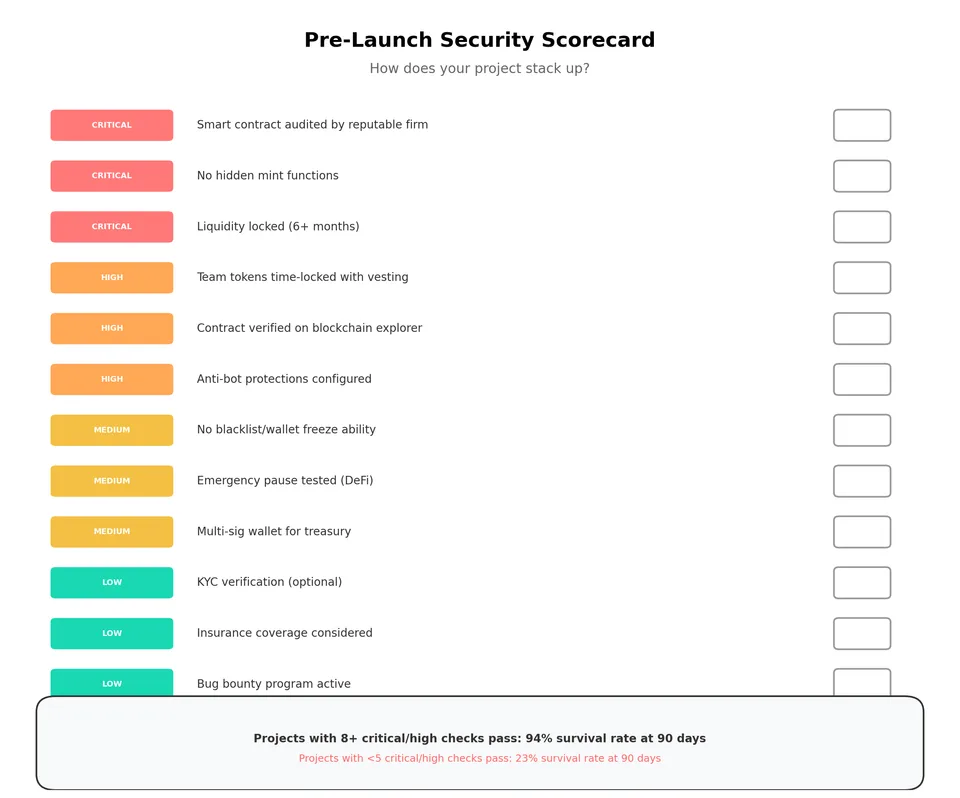
Smart Contract Security Checklist
Pre-Launch:
·[ ] Contract audited by reputable firm (CertiK, Hacken, OpenZeppelin, Trail of Bits, or equivalent)
·[ ] No hidden mint functions
·[ ] No ability to blacklist wallets (unless required for compliance — document clearly)
·[ ] No ability to change taxes after launch (unless time-locked and transparent)
·[ ] Liquidity locked for minimum 6 months (1 year preferred)
·[ ] Team tokens time-locked with vesting schedule
·[ ] Contract verified on blockchain explorer (Etherscan, Solscan, Basescan, etc.)
·[ ] Anti-bot protections considered (max wallet limits, launch delay)
·[ ] Emergency pause functions tested (for DeFi/utility)
·[ ] Upgradeability paths documented (if applicable)
Common Scams and How to Avoid Them
Rug Pulls
·Creator drains liquidity or sells all tokens
·Prevention: Lock liquidity, renounce ownership (where appropriate), KYC verification, transparent team
Honeypots
·Token can be bought but not sold
·Prevention: Audit contract before launch, test trading on small amounts, verify on explorer
Pump and Dumps
·Coordinated buying to inflate price, then mass selling
·Prevention: Anti-whale measures, transparent tokenomics, community education, vesting schedules
Fake Contracts
·Scammers create tokens with similar names to popular projects
·Prevention: Verify contract address from official sources only, never from search results or DMs
MEV and Bot Exploitation
·Bots front-run trades or manipulate prices
·Prevention: Use anti-bot launch mechanisms, consider MEV protection tools, fair launch sequencing
Governance Attacks (DeFi/DAO)
·Hostile actors acquire voting power and pass harmful proposals
·Prevention: Timelocks on governance actions, quorum requirements, delegation mechanisms, vote-locking
The "Verifiable Launch" Framework
Founders who want longevity must assume the market starts skeptical. Build a "verifiable launch":
Pre-launch smart contract audit — Identify owner privilege risks, hidden minting, blacklist logic
Liquidity lock with clear terms — Publish lock duration, transaction hash, conditions for changes
Time-locked team allocations — Predictable vesting reduces "announcement dumps"
Anti-bot and launch fairness planning — Phased liquidity, max wallet limits, transparent timing
KYC verification — Optional but increasingly expected for serious projects
Open-source verification — Publish and verify code so anyone can inspect it
Security Audit Costs (2026)
Audit Type | Cost Range | Timeline | Best For |
|---|---|---|---|
Basic automated scan | $500–$2,000 | 1–3 days | Meme coins, simple tokens |
Standard manual audit | $3,000–$10,000 | 1–2 weeks | Most utility/governance tokens |
Comprehensive audit + remediation | $10,000–$50,000+ | 2–4 weeks | DeFi protocols, complex contracts |
Top-tier firm (Trail of Bits, OpenZeppelin) | $50,000–$200,000+ | 4–8 weeks | Major DeFi, RWA, institutional |
For most meme coin and utility launches, a standard manual audit is the sweet spot of credibility and cost. For DeFi protocols, comprehensive audits are mandatory. For RWA and institutional projects, top-tier audits are expected.
Chapter 16 — Marketing Before and After Launch
Marketing is not a one-time event. It's a continuous process that starts weeks before launch and continues for the life of the project.
Pre-Launch Marketing (4–8 Weeks Before)
Content Marketing:
·Twitter threads explaining the concept
·Behind-the-scenes content (development, design, team)
·Teaser graphics and videos
·Educational content about the problem you're solving
·For DeFi: technical explainers, risk analyses, comparison posts
·For RWA: regulatory explainers, market opportunity research, institutional perspectives
Influencer Marketing:
·Micro-influencers (1K–10K followers): $50–$500 per post, high engagement, niche audiences
·Mid-tier influencers (10K–100K followers): $500–$5,000 per post, best ROI for most projects
·Macro influencers (100K+ followers): $5,000–$50,000+ per post, broad reach, lower engagement rates
·Crypto-native KOLs: Often prefer token allocations or long-term partnerships over one-time payments
Pro tip: Mid-tier influencers (10K–100K followers) typically deliver better engagement rates and ROI than mega-influencers for on-chain launches. For RWA/institutional projects, target fintech and TradFi influencers instead of pure crypto KOLs.
Community Building:
·Telegram/Discord growth campaigns
·Airdrop announcements
·Meme contests or technical challenges
·Partnership teasers
·Beta testing programs (for utility/DeFi)
PR and Media:
·Press releases on crypto news sites (CoinDesk, The Block, Cointelegraph)
·Guest posts on crypto blogs and Substack newsletters
·Podcast appearances
·Founder interviews
·For RWA: TradFi media, regulatory publications, investor forums
Launch Week Marketing
Coordinated Campaign:
·All influencers post within a tight window (2–4 hours)
·Twitter trending hashtag campaigns
·Reddit AMAs
·Live Twitter Spaces launch event
·Telegram voice chat launch party
·For DeFi: liquidity mining announcements, staking go-live
Paid Amplification:
·Twitter/X promoted posts
·Crypto-specific ad networks (CoinMarketCap, Dextools, DEXScreener)
·Reddit ads in crypto communities
·TikTok/Shorts promotion
·For institutional: LinkedIn ads, fintech publications
Post-Launch Marketing (Days 2–30)
Week 1:
·Daily content across all channels
·Holder/user milestone celebrations
·Community highlight features
·Address any FUD immediately
·For utility: user onboarding support, feature highlights, bug fix updates
Week 2–3:
·Submit CoinGecko and CoinMarketCap listings
·Begin longer-form content (blog posts, Medium articles, research papers)
·Pursue additional influencer partnerships
·Plan first community event or AMA
·For DeFi: publish protocol metrics, yield comparisons, risk reports
Week 4:
·Analyze first month's data
·Double down on what worked
·Cut what didn't
·Plan Month 2 strategy
·For DAOs: publish first governance summary, proposal retrospectives
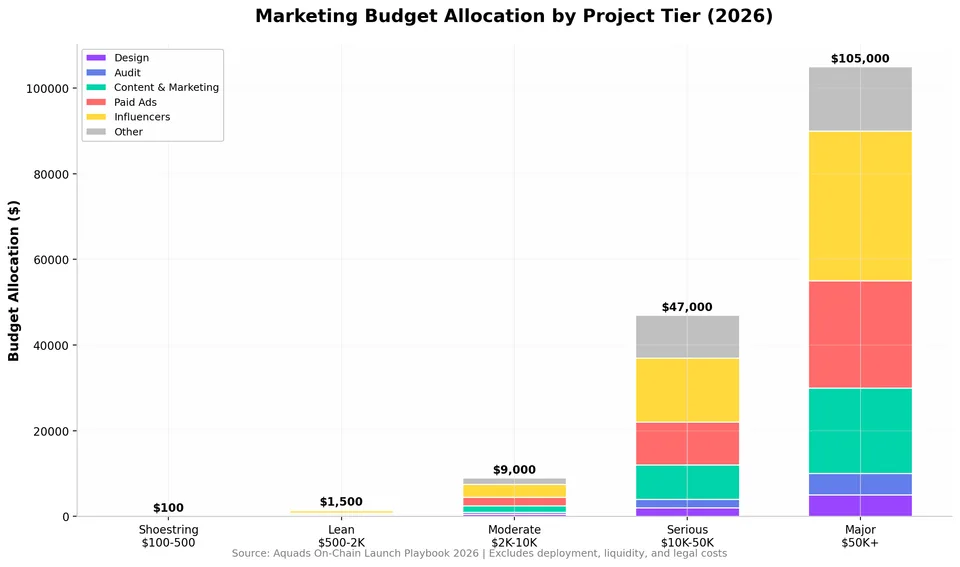
Marketing Budgets: Realistic Numbers
Budget Level | Total Spend | What It Gets You |
|---|---|---|
Shoestring ($100–$500) | $100–$500 | DIY design, basic social media, small airdrop, organic growth only |
Lean ($500–$2,000) | $500–$2,000 | Freelance design, 2–3 micro-influencers, basic website, small paid ads |
Moderate ($2,000–$10,000) | $2,000–$10,000 | Professional branding, 5–10 mid-tier influencers, paid ads, PR, community tools |
Serious ($10,000–$50,000) | $10,000–$50,000 | Full agency support, 10–20 influencers across platforms, heavy paid amplification, CEX listing pursuit |
Major ($50,000+) | $50,000+ | Comprehensive campaign, top-tier influencers, market makers, Tier-1 CEX listing, ongoing agency retainer |
Important: These are marketing-only estimates. Add deployment, audit, liquidity, legal, and listing costs on top.
AI Tools That Save Time
In 2026, AI has become an integral part of on-chain project marketing:
Content Creation:
·Midjourney / DALL-E — Generate visual content, memes, branding assets
·ChatGPT / Claude — Draft social media posts, blog content, announcements, technical documentation
·Runway / Pika — Create short video content
·ElevenLabs — AI voiceovers for video content
Community Management:
·AI moderation bots — Filter spam, answer FAQs, manage Telegram/Discord
·Sentiment analysis tools — Monitor community mood across platforms
·Auto-translation — Reach non-English speaking communities
Analytics:
·On-chain analytics — Track holder behavior, whale movements, volume patterns
·Social listening tools — Monitor mentions, sentiment, trending topics
·Competitive analysis — Track what other successful projects are doing
Caution: AI can speed up production, but trust still comes from human connection. Use AI to amplify, not replace, genuine community engagement. For RWA and institutional projects, AI-generated content must be reviewed for compliance and accuracy.
Chapter 17 — Listings and Tracking Platforms
Getting listed on major tracking platforms is a critical milestone that signals legitimacy and makes your token discoverable to millions of potential users and investors.
CoinGecko Listing
Requirements:
·Active trading on at least one exchange tracked by CoinGecko
·Functional website and block explorer
·Verified contract address
·Accurate circulating and total supply data
·Active social media presence
·Transparent project documentation
Application Process:
Prepare information package (name, symbol, logo, contract, website, whitepaper)
Confirm exchange eligibility (DEX or CEX)
Submit via official CoinGecko Request Form
Review typically takes 2–6 weeks
5.Maintain data accuracy post-approval
Pro tip: Listing on a major DEX like Uniswap, PancakeSwap, or Raydium that CoinGecko already tracks significantly speeds up approval.
CoinMarketCap Listing
Requirements:
·Traded publicly on at least one exchange with material volume
·Functional website and block explorer
·Representative from the project for communication
·Leverage cryptography, consensus algorithms, or smart contracts
·Non-trivial trading activity and volume
Evaluation Framework: CoinMarketCap evaluates projects across multiple factors:
Trading volume and market pairs
Community interest and engagement
Traction and progress
Team credibility
Product/market fit
Impact and practicality
Uniqueness and innovation
Project longevity and activity
Application Tips:
·Use the online submission form only — don't reach out through other channels
·Provide complete, well-structured information with evidence
·Avoid hyperbole and vague statements
·Be truthful — false claims can result in permanent disqualification
·Don't submit duplicate requests
Timeline: 2–4 weeks for approval after complete submission
DEXScreener / DEXTools / Birdeye
These platforms track DEX trading in real-time and are essential for on-chain visibility:
·DEXScreener — Automatically lists most DEX tokens once liquidity is created
·DEXTools — Popular for Ethereum and BNB Chain projects
·Birdeye — Solana-focused tracking
·AstroTools / Defined — Multi-chain alternatives
Getting featured/trending:
·Organic trading volume is the primary factor
·Some platforms offer paid trending spots (use cautiously)
·Community-driven voting can help visibility
Centralized Exchange (CEX) Listings
Tier 3 Exchanges (Easiest):
·MEXC, Gate.io, Bitget, LBank, XT.com
·Requirements: Basic volume, active community, clean contract
·Cost: $1,000–$10,000 (or free if volume is strong)
·Best for: Meme coins, early-stage projects
Tier 2 Exchanges:
·KuCoin, Bybit, OKX, Bitfinex
·Requirements: Strong volume ($100K+ daily), active community, audit
·Cost: $10,000–$50,000
·Best for: Established projects with traction
Tier 1 Exchanges (Most difficult):
·Binance, Coinbase, Kraken
·Requirements: Massive volume, regulatory compliance, institutional interest, strong team
·Cost: $50,000–$1,000,000+ or applied for organically
·Best for: Only the most successful projects
Strategy: Most projects start on DEXs, build volume and community, then pursue Tier 3 and Tier 2 CEXs. Tier 1 listings are long-term goals for only the most successful projects. For RWA/institutional tokens, Tier 1 listings are often required for credibility and investor access.
Chapter 18 — Scaling Your Project
Launch day is just the beginning. The projects that survive and thrive are those that think beyond the initial pump.
The Post-Launch Growth Framework
Days 2–7: Consolidation
·Maintain content cadence
·Address all community questions
·Fix any technical issues
·Analyze launch data
·Begin CoinGecko/CoinMarketCap applications
·For utility: onboard users, fix bugs, iterate based on feedback
·For DeFi: monitor protocol health, ensure oracle accuracy, track liquidity
Weeks 2–4: Expansion
·Launch first community initiative (contest, AMA, partnership)
·Begin longer-form content strategy
·Pursue additional exchange listings
·Evaluate marketing ROI and reallocate budget
·Plan first utility or ecosystem expansion
·For DAOs: publish first governance proposals, activate voting
·For DeFi: introduce new pools, collateral types, or integrations
Months 2–3: Maturation
·Introduce staking or rewards program
·Launch NFT collection or merchandise
·Pursue strategic partnerships
·Begin governance experiments (if applicable)
·Consider charitable initiative or community fund
·For utility: release new features, expand integrations
·For RWA: add new asset classes, expand custody partnerships
Months 3–6: Evolution
·Evaluate new chain expansion (multi-chain presence)
·Develop additional utilities (games, DeFi integrations, AI features)
·Build developer ecosystem if applicable
·Plan for long-term sustainability
·For DeFi: introduce protocol fees, revenue sharing, or buyback mechanisms
·For DAOs: transition to full on-chain governance, delegate responsibilities
Metrics That Matter
Don't just track price. Monitor:
On-Chain Metrics:
·Unique holder count (and growth rate)
·Daily active wallets
·Transaction volume
·Average hold time
·Whale wallet concentration
·For DeFi: TVL (Total Value Locked), utilization rates, liquidation health
·For utility: active users, retention rates, feature usage
Social Metrics:
·Follower growth (real, not bot-inflated)
·Engagement rate (comments, shares, real interactions)
·Community size (Telegram/Discord active members)
·Sentiment analysis
·Governance participation (for DAOs)
Business Metrics:
·Cost per acquired user/holder
·Community activation rate
·Content reach and virality
·Partnership and PR milestones
·For DeFi: revenue generated, fee capture, LP retention
·For RWA: assets under tokenization, redemption volume, institutional partnerships
Long-Term Sustainability Strategies
1. Revenue Generation
·Transaction fees (if built into tokenomics or protocol)
·NFT sales
·Merchandise
·Premium community features
·Partnership revenue
·For DeFi: protocol fees, liquidation revenue, borrow/lend spreads
·For utility: SaaS fees, API usage, premium tiers
2. Treasury Management
·Diversify treasury (don't hold 100% in your own token)
·Transparent treasury reports
·Community input on major expenditures (for DAOs)
·For DeFi: build protocol-owned liquidity, insurance funds
3. Continuous Innovation
·Regular product updates
·New features and utilities
·Cross-chain expansion
·Ecosystem partnerships
·For governance: iterate on voting mechanisms, delegate systems, reputation models
4. Governance Evolution (For DAOs/Governance Tokens)
·Transition from team-controlled to full DAO
·Community voting on key decisions
·Transparent proposal process
·Time-locked execution for major changes
·Capture resistance: design governance to resist plutocracy and hostile takeovers
Chapter 19 — Common Mistakes by Project Type
Learn from others' failures. Here are the most common mistakes we see in 2026, organized by project type.
Universal Mistakes (All Projects)
1. Overpromising and Underdelivering
·The mistake: Announcing massive roadmaps with unrealistic timelines.
·The fix: Under-promise and over-deliver. Surprise your community with early delivery rather than disappoint with delays.
2. Ignoring FUD
·The mistake: Letting fear, uncertainty, and doubt spread unanswered.
·The fix: Address concerns directly and transparently. Silence allows narratives to form without your input.
3. Neglecting the Community After Launch
·The mistake: Going quiet after launch week.
·The fix: Community management is a daily job, not a launch-week activity. Hire or appoint dedicated community managers.
4. Focusing Only on Price
·The mistake: Measuring success solely by token price.
·The fix: Track holder growth, engagement, community health, and ecosystem development. Price is a lagging indicator of value.
5. Inconsistent Branding
·The mistake: Changing visual identity, tone, or messaging frequently.
·The fix: Establish brand guidelines early and stick to them. Consistency builds recognition.
6. Poor Tokenomics
·The mistake: Complex or unfair token distribution.
·The fix: Keep it simple, transparent, and fair. When in doubt, favor the community over insiders.
7. Launching Without a Team
·The mistake: One person trying to do everything.
·The fix: Even a small team of 3–5 people with clear roles dramatically increases success odds.
8. Copying Other Projects
·The mistake: Creating a clone of a successful project with no differentiation.
·The fix: Find your unique angle. The market doesn't need another generic project.
Meme Coin-Specific Mistakes
9. No Story or Cultural Hook
·Meme coins without a narrative are just random tickers. Build a story people want to be part of.
10. Launching Without Community
·The #1 mistake. A token with no social presence, no engaged followers, and no pre-launch momentum is almost guaranteed to fail.
11. Complex Tokenomics
·Meme coins should be simple. Excessive taxes, confusing reflections, or elaborate mechanisms scare retail investors.
Utility / DeFi-Specific Mistakes
12. Token Without Product
·Launching a token before the product works is putting the cart before the horse. The token derives value from the product, not the other way around.
13. Unsustainable Emissions
·Inflationary rewards without a path to fee-based sustainability create permanent sell pressure.
14. Overly Permissive Governance
·Giving governance too much power too early invites attacks and bad decisions. Minimize governance where possible; harden it where necessary.
15. Ignoring Composability Risks
·DeFi protocols interact with other protocols. A bug in an integrated contract can cascade. Test integrations thoroughly.
RWA / Institutional-Specific Mistakes
16. Insufficient Legal Structure
·Tokenizing real-world assets without proper legal wrappers, custody, and compliance is reckless. Engage counsel before writing code.
17. Lack of Transparency
·RWA investors demand proof of reserves, audit reports, and legal enforceability. Opaque operations destroy trust.
18. Ignoring Accreditation Requirements
·Selling security-like tokens to unaccredited retail investors violates securities laws in most jurisdictions. Structure offerings correctly.
Governance / DAO-Specific Mistakes
19. Low Participation
·Governance tokens with <5% voter turnout are vulnerable to capture. Incentivize participation and lower barriers to voting.
20. Plutocracy
·1-token-1-vote systems let whales dominate. Consider time-weighted voting, quadratic voting, or reputation systems.
Chapter 20 — Frequently Asked Questions
How much does it cost to launch a token in 2026?
Minimum viable launch (meme coin): $100–$500 (DIY on Pump.fun or similar, basic design, organic marketing)
Professional launch (meme/community): $5,000–$20,000 (custom branding, audit, influencer campaign, paid ads, website)
Utility token launch: $10,000–$50,000 (development, audit, legal review, marketing, website)
DeFi protocol launch: $50,000–$500,000+ (development, multiple audits, testnet, bug bounty, liquidity, marketing)
RWA / security token launch: $100,000–$1M+ (legal structuring, custody, compliance, development, audits, institutional marketing)
The technical deployment can cost as little as $2–$100. The real cost is in development, legal, branding, marketing, and community building.
Is it legal to launch a token?
In the United States, the SEC-CFTC joint interpretive release of March 2026 clarified that most crypto assets fall outside securities law. Digital commodities, collectibles, and tools are explicitly not securities. However, digital securities (investment contracts, tokenized stocks/bonds) remain under SEC jurisdiction.
Key legal considerations:
·Don't promise financial returns or investment profits
·Be transparent about the token's purpose
·Avoid misleading marketing about price appreciation
·Consider consulting a crypto-savvy attorney in your jurisdiction
·For EU projects: comply with MiCA registration and white paper requirements
·Be aware that regulations vary significantly by country
How long does it take to launch a token?
Meme coin (technical only): 1 hour to 1 day Meme coin (professional preparation): 2–6 weeks Utility token: 1–3 months (development + marketing) DeFi protocol: 3–6 months (development, testnet, audits) RWA token: 6–12 months (legal structuring, compliance, custody, development)
What's the best blockchain for my project?
Meme coins / retail: Solana, Base, BNB Chain DeFi / governance: Ethereum, Base, Arbitrum RWA / institutional: Ethereum, Avalanche, Polygon Gaming / NFTs: Solana, Sui, Immutable X Social / creator: Solana, Base, Lens
The "best" chain depends on your project type, audience, and technical requirements.
Can I launch a token anonymously?
Yes, but it significantly reduces trust. In 2026, projects with transparent, communicative teams consistently outperform anonymous launches. If you must remain anonymous, compensate with extra transparency in other areas (locked liquidity, audited contracts, clear tokenomics, open-source code).
For RWA and institutional projects, anonymity is essentially impossible—regulatory compliance requires identified responsible parties.
How do I avoid looking like a rug pull?
·Lock liquidity and publish proof
·Get a smart contract audit
·Be active and transparent on social media
·Don't hold an excessive portion of the supply
·Use time-locked vesting for team tokens
·Consider KYC verification
·Build community BEFORE launch, not after
·Open-source your code where possible
What should I do if my launch flops?
1.Don't panic — Many successful projects had slow starts
2.Analyze why — Was it timing, marketing, concept, or execution?
3.Communicate with your community — Be honest about the situation
4.Pivot if needed — Adjust branding, messaging, or strategy
5.Keep building — Consistent effort often beats perfect timing
6.Set a timeline — Decide how long you'll continue before reassessing
For utility/DeFi projects, a "flop" might mean low user adoption rather than low price. In that case, focus on product improvement and user feedback rather than marketing.
How important are exchange listings?
CoinGecko and CoinMarketCap listings are essential for discoverability for all project types. CEX listings are valuable but not required for initial success. Many projects build significant communities and volume purely through DEX trading before pursuing CEX listings.
For RWA/institutional projects, CEX listings (especially Tier 2+) are often required for investor access and credibility.
Should I hire a marketing agency?
If you have the budget ($5,000+), a specialized crypto marketing agency can accelerate growth significantly. If your budget is limited, focus on organic community building and micro-influencer partnerships. DIY marketing is viable but requires significant time investment.
For RWA/institutional projects, consider fintech PR firms and investor relations specialists rather than pure crypto marketing agencies.
What's the #1 mistake new founders make?
For meme coins: Launching without a community. A token with no social presence, no engaged followers, and no pre-launch momentum is almost guaranteed to fail.
For utility/DeFi: Launching a token before the product works. The token should be the last step, not the first.
For RWA: Insufficient legal preparation. Tokenizing real assets without proper legal structure is a liability nightmare.
Do I need a lawyer?
Meme coins: Recommended but not mandatory. A quick legal review of your marketing materials and token structure can prevent regulatory issues.
Utility/governance: Recommended. Ensure your token is structured as a Digital Tool or Digital Commodity, not an investment contract.
DeFi: Highly recommended. Compliance with the SEC-CFTC framework, potential securities analysis for yield-bearing features, and protocol risk disclosures.
RWA/security tokens: Mandatory. Securities counsel, regulatory filings, and jurisdiction-specific compliance are non-negotiable.
EU projects: Recommended for all types. MiCA compliance requires specific disclosures and registration.
Chapter 21 — Complete 50-Point Launch Checklist
Concept & Planning
·[ ] Project type is clearly defined (meme, utility, governance, DeFi, RWA, social)
·[ ] Concept is memorable and differentiated
·[ ] Target audience is clearly defined
·[ ] Name is unique, available across platforms, and easy to spell
·[ ] Visual identity (logo, colors, mascot) is designed
·[ ] Brand guidelines are documented
·[ ] Project story/narrative is written and compelling
·[ ] Tokenomics are designed, simple, and transparent
·[ ] Budget is allocated across all needed categories
·[ ] Legal considerations are reviewed and documented
·[ ] Regulatory category is determined (commodity, collectible, tool, security)
·[ ] Contingency plan exists for slow launch
·[ ] For utility/DeFi: product-market fit is validated with real users
·[ ] For RWA: legal structure and custody are confirmed
Technical
·[ ] Blockchain is selected and tested
·[ ] Token standard is chosen (ERC-20, SPL, ERC-721, ERC-1155, etc.)
·[ ] Smart contract is developed and tested
·[ ] Contract is audited by reputable firm
·[ ] No hidden functions (mint, blacklist, tax changes)
·[ ] Liquidity lock is prepared (for DEX launches)
·[ ] Team token vesting is configured
·[ ] Anti-bot measures are considered
·[ ] Contract is verified on blockchain explorer
·[ ] Wallet security is established (hardware wallet, multi-sig if team)
·[ ] Test transactions completed successfully
·[ ] For DeFi: testnet deployment is live and functional
·[ ] For RWA: compliance controls and transfer restrictions are tested
Legal & Compliance
·[ ] Marketing materials reviewed for regulatory compliance
·[ ] No promises of financial returns in any communications
·[ ] Token purpose is clearly documented
·[ ] For EU projects: MiCA white paper prepared (if applicable)
·[ ] For RWA: securities counsel engaged, exemptions determined
·[ ] For security tokens: investor accreditation checks implemented
·[ ] Terms of service and risk disclosures published
Pre-Launch Marketing
·[ ] Twitter/X account is active with 2+ weeks of content
·[ ] Telegram group is active with real conversations
·[ ] Discord server is set up (if using)
·[ ] Website is live and mobile-optimized
·[ ] All social links are functional
·[ ] Influencer partnerships are confirmed
·[ ] Launch day content calendar is prepared
·[ ] Community moderators are trained and scheduled
·[ ] Airdrop/giveaway mechanics are tested
·[ ] Press release or PR plan is ready
·[ ] For DeFi: documentation and GitHub repository are public
·[ ] For RWA: investor materials and legal docs are ready
Launch Day
·[ ] Exact launch time is announced
·[ ] Contract address is triple-checked
·[ ] All team members know their roles
·[ ] Liquidity is deployed and locked (if applicable)
·[ ] Contract address posted across all channels simultaneously
·[ ] Pinned tweets/posts are updated
·[ ] Influencer posts are coordinated
·[ ] Community raids are organized (if applicable)
·[ ] Technical monitoring is active
·[ ] Team is present in all channels for 12+ hours
·[ ] For utility: product is live and accessible
·[ ] For DeFi: protocol metrics and oracles are monitored
Post-Launch (Week 1)
·[ ] Daily content is published
·[ ] Community questions are answered promptly
·[ ] Volume and holder milestones are celebrated
·[ ] CoinGecko application is submitted
·[ ] CoinMarketCap application is submitted
·[ ] DEXScreener/DEXTools presence is verified
·[ ] Any technical issues are addressed immediately
·[ ] First community event or AMA is scheduled
·[ ] Marketing performance is analyzed
·[ ] Week 2 content plan is prepared
·[ ] For utility: user feedback is collected, bugs are triaged
·[ ] For DeFi: protocol health metrics are monitored daily
Post-Launch (Month 1)
·[ ] Listing on CoinGecko is approved
·[ ] Listing on CoinMarketCap is approved
·[ ] Community growth tactics are evaluated
·[ ] Influencer ROI is measured
·[ ] Token holder retention is tracked
·[ ] First partnership or collaboration is pursued
·[ ] Content strategy is refined based on data
·[ ] Community feedback is collected and acted upon
·[ ] Treasury management plan is implemented
·[ ] Month 2 roadmap is finalized and shared
·[ ] For DAOs: first governance proposals are drafted
·[ ] For DeFi: revenue/fee metrics are analyzed, sustainability assessed
Conclusion
Launching an on-chain project in 2026 is both easier and harder than ever before.
Easier because the tools are better, the costs are lower, the infrastructure is more mature, and regulatory clarity has finally arrived. Harder because the competition is fiercer, the audience is more skeptical, and the bar for success has been raised across every project type.
Whether you're launching a meme coin that captures a cultural moment, a DeFi protocol that reimagines finance, a governance token that decentralizes decision-making, or an RWA platform that bridges traditional and on-chain assets, the fundamentals remain the same:
·Tell a story or solve a problem that people care about
·Build genuine communities, not just follower counts
·Operate with transparency and consistency
·Think beyond launch day to long-term value
·Adapt quickly to changing market conditions and regulations
·Treat your community as partners, not customers
·Choose your technical and legal architecture deliberately
This playbook is your foundation. The execution is up to you.
Good luck. Build something worth remembering.
This guide was produced by Aquads — a full-stack project hub for on-chain projects. For tools, resources, and services to help launch and grow your project, visit aquads.xyz.
https://www.aquads.xyz/learn/how-to-launch-a-token-on-bnb-chain-in-2026-the-6a593f4fb4159751b3616e42
Sources & Further Reading
Regulatory Frameworks
- SEC-CFTC Joint Interpretive Release 33-11412 (March 17, 2026) — Token Taxonomy Framework
- SEC Staff Statement on Meme Coins (February 2025)
- GENIUS Act (July 2025) — Stablecoin Regulation
- Markets in Crypto-Assets (MiCA) Regulation (EU) 2023/1114
- ESMA Interim MiCA Register (2026)
Token Standards & Technical Architecture
- Ethereum ERC-20, ERC-721, ERC-1155, ERC-777, ERC-4626 Specifications
- Solana SPL Token & Token-2022 Documentation
- Chainlink — ERC-721 vs ERC-1155 Explained (2026)
- Bitquery — ERC vs SPL Token Standards (2024)
Tokenomics & DeFi Design
- Smart Contracts Tools — Tokenomics Design for Sustainable DeFi (2026)
- FinDaS — Understanding DeFi Tokenomics (2026)
- Frontiers in Blockchain — Tokenomics Design Method (2026)
Security & Auditing
- CertiK, Hacken, OpenZeppelin Audit Standards
- Assure DeFi — Rug Pull Prevention Framework
Marketing & Launch Strategy
- TokenMinds — Meme Coin Marketing Guide (2026)
- Blocktunix — Token Launch Cost Breakdown (2026)
- CoinMarketCap — Listing Criteria & Methodology (2026)
- CoinGecko — Listing Terms & Methodology (2026)
Industry Analysis
- Binance Research — SEC-CFTC Landmark Guidance Analysis (2026)
- Dentons — SEC Clarifies Crypto Asset Regulation (2026)
- GoFaizen-Sherle — Commodity Tokenization Regulation (2026)