How to Launch a Token on Solana in 2026
The Complete Guide to Creating, Deploying, and Growing Your Project on the Solana Blockchain
This guide is part of the Aquads On-Chain Launch Playbook. For the foundational framework covering project vision, legal considerations, tokenomics, and universal launch strategies, start with the Complete Playbook for Launching On-Chain Projects in 2026.
Table of Contents
Why Launch on Solana?
What You Need Before You Start
Choosing Your Launch Method
No-Code Token Creation: The Full Breakdown
Developer Route: SPL & Token-2022
Creating Liquidity and Making Your Token Tradable
Security on Solana: Locking, Audits & Anti-Bot
Marketing Your Solana Token
Growing a Solana Community
Post-Launch: Listings, Volume, and Scaling
Real Costs: A Complete Budget Breakdown
Common Solana-Specific Mistakes
FAQ
Chapter 1 — Why Launch on Solana?
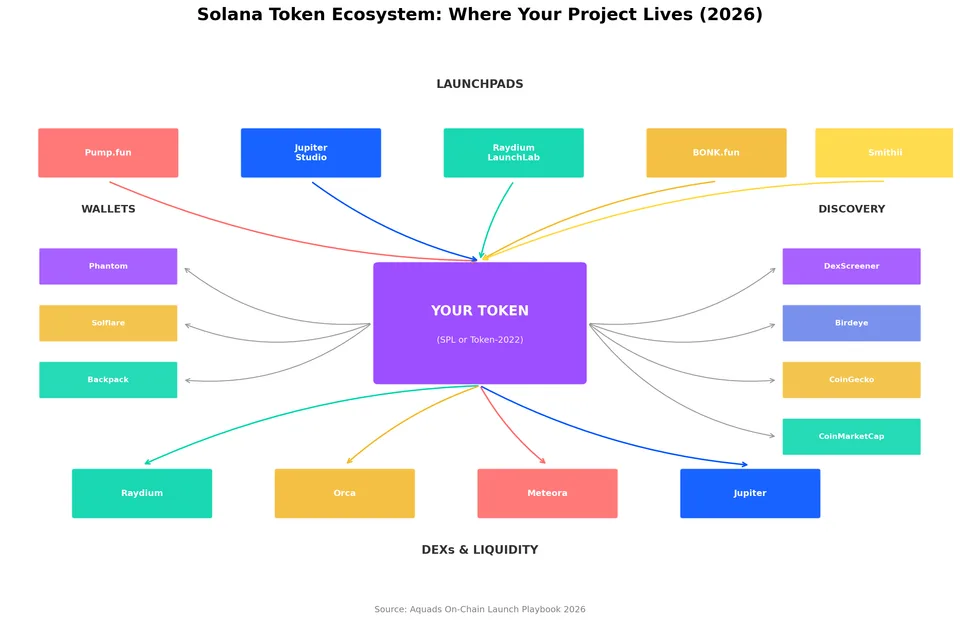
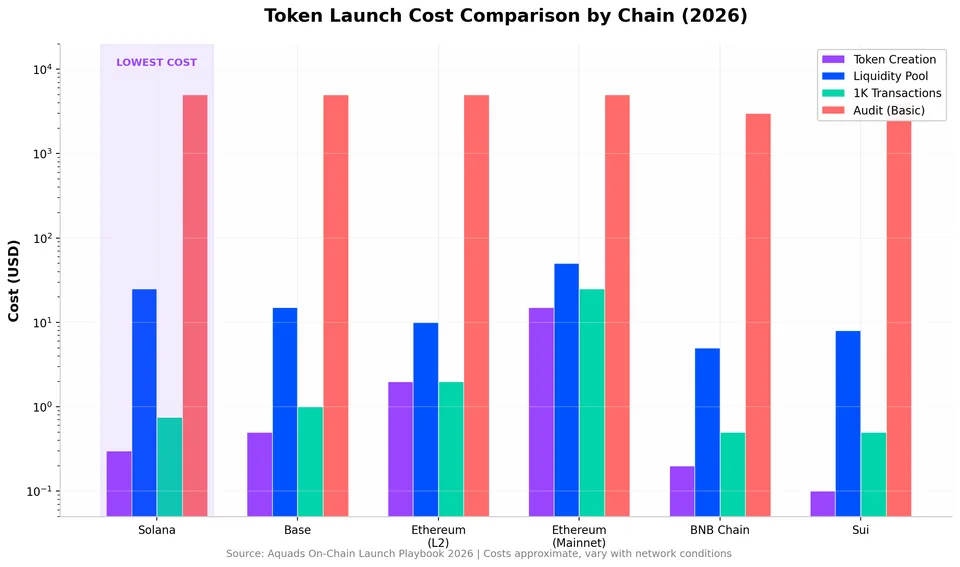
Solana has become the dominant chain for retail token launches in 2026. With 65,000+ theoretical transactions per second, sub-second finality, and transaction costs typically under $0.01, it offers the lowest friction environment for launching and trading tokens of any major blockchain.
The Numbers That Matter
6+ million tokens have been created on Solana launchpads, with Pump.fun alone commanding over 70% market share.
$160 billion+ in cumulative DEX volume has flowed through Solana's ecosystem.
Sub-$0.01 average transaction cost makes micro-transactions, airdrops, and community engagement economically viable.
Phantom, Solflare, and Backpack wallets have onboarded millions of retail users with mobile-first experiences.
What Solana Is Best For
Project Type | Solana Fit | Why |
|---|---|---|
Meme coins / community tokens | Excellent | Lowest cost, fastest trading, biggest retail audience, Pump.fun ecosystem |
Gaming / NFTs | Excellent | High throughput, low-cost NFT minting, Metaplex infrastructure |
DeFi / governance | Good | Growing Jupiter, Raydium, Orca, Meteora ecosystems; lower fees than Ethereum |
Utility tokens | Good | Fast transactions, SPL standard simplicity, growing developer tools |
RWA / institutional | Moderate | Less institutional infrastructure than Ethereum; improving with Token-2022 |
The Trade-Offs
Competition is extreme. Thousands of tokens launch weekly on Solana. Standing out requires exceptional branding, community building, and marketing—not just low fees.
Network reliability has improved but historically experienced outages. In 2026, stability has significantly improved with Firedancer and other client diversity efforts.
Institutional credibility lags Ethereum. For RWA tokens or institutional DeFi, Ethereum or Base may still be preferred.
Chapter 2 — What You Need Before You Start
Essential Setup (15 Minutes)
1. A Solana Wallet
Choose one of the three dominant wallets:
Phantom — Most popular, excellent mobile app, built-in token discovery, NFT support
Solflare — Strong DeFi integrations, staking features, browser + mobile
Backpack — Exchange-integrated, clean UX, growing ecosystem support
Download from official sources only. Never use search results or DMs to find wallet links. Bookmark the official URLs.
2. SOL for Fees
You'll need SOL for:
Token creation: ~0.002–0.3 SOL (~$0.30–$45) depending on method
Liquidity pool creation: ~0.1–0.7 SOL (~$15–$105)
Transaction fees: ~0.000005 SOL (~$0.00075) per transaction
Priority fees (optional): Variable, typically 0.0001–0.01 SOL (~$0.015–$1.50)
Budget 0.5–2 SOL (~$75–$300) for a basic launch. For a professional launch with liquidity, marketing, and anti-bot measures, budget 5–20 SOL (~$750–$3,000).
3. A Burner Wallet (Recommended)
For testing and interacting with unknown contracts, use a separate wallet with minimal funds. Never test new launchpads with your primary wallet holding significant assets.
Chapter 3 — Choosing Your Launch Method
Solana offers more launch pathways than any other chain. Your choice depends on your technical skill, budget, timeline, and project type.
The Six Launch Methods on Solana
Method | SOL Cost | USD Cost | Time | Skill Level | Best For |
|---|---|---|---|---|---|
Pump.fun | ~0.002 SOL | ~$0.30 | 5 minutes | None | Meme coins, viral experiments, community tokens |
BONK.fun | ~0.002 SOL | ~$0.30 | 5 minutes | None | Meme coins targeting BONK community |
Bags | ~0.002 SOL | ~$0.30 | 5 minutes | None | Creator rewards, community launches |
Jupiter Studio | ~0.01–0.1 SOL | ~$1.50–$15 | 10 minutes | Low | Structured launches, anti-sniping, Jupiter ecosystem |
Raydium LaunchLab | ~0.1–0.5 SOL | ~$15–$75 | 15 minutes | Low | DEX-native control, custom curve parameters |
Smithii / Solr (No-Code) | 0.1–0.6 SOL | ~$15–$90 | 10 minutes | None | Professional launches, SPL + Token-2022, advanced features |
Custom SPL/Token-2022 | ~0.002 SOL + dev cost | ~$0.30 + dev | 1–7 days | Medium-High | Utility tokens, DeFi, governance, custom tokenomics |
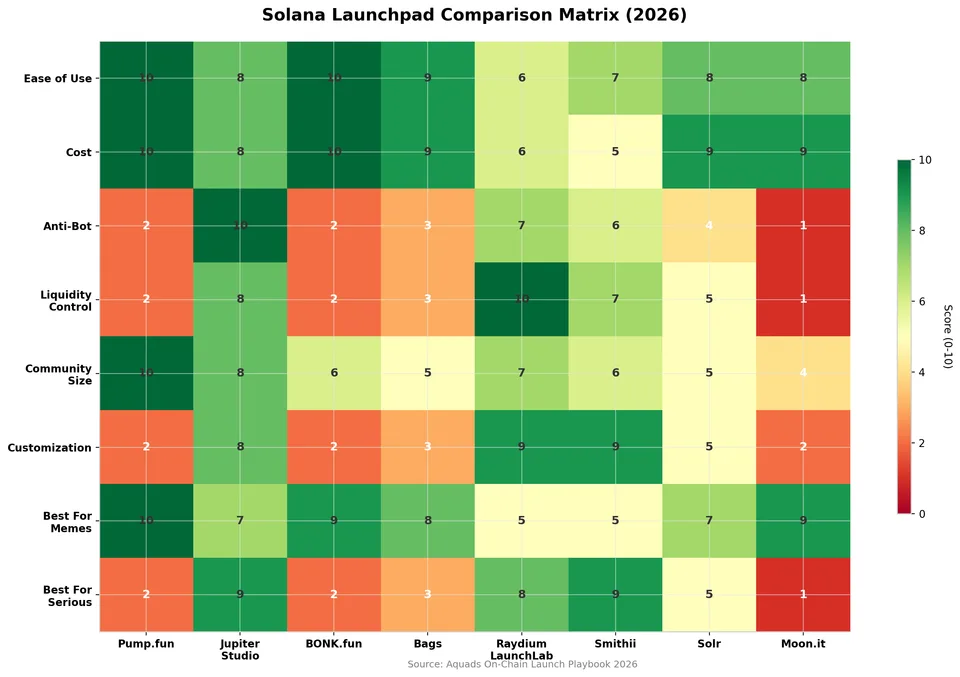
Launchpad Deep Dive
Pump.fun — The Default Choice
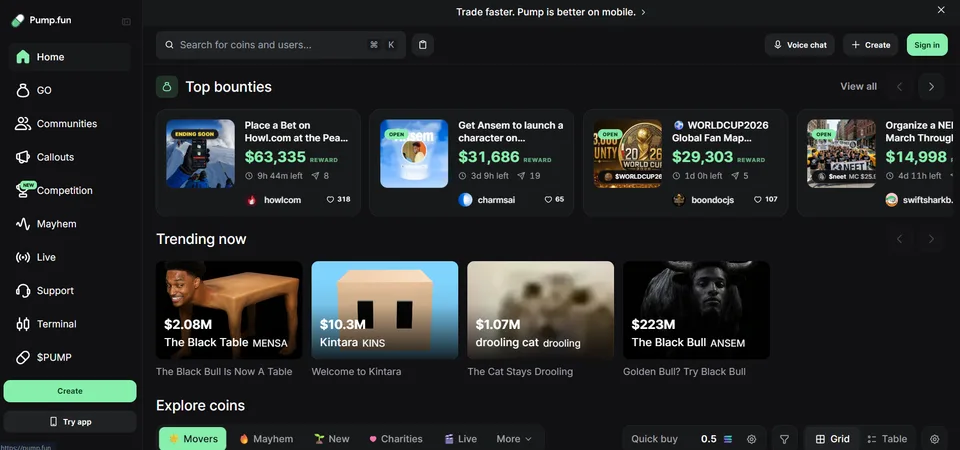
Pump.fun dominates Solana memecoin launches with over 70% market share and 6+ million tokens created. It uses a bonding curve: as more people buy, the price rises. When market cap hits ~$69,000, the token automatically graduates to a Raydium liquidity pool.
Cost: Free creation (only network gas ~0.002 SOL / ~$0.30)
Fees: 1.25% on bonding curve; post-graduation fees vary by market cap (1.25% down to 0.30%)
Pros: Fastest, simplest, biggest audience, automatic graduation
Cons: Extreme competition, 1% trading fee, many tokens fail to graduate, limited customization
Best for: Meme coins, viral experiments, first-time creators
Jupiter Studio — The Structured Alternative
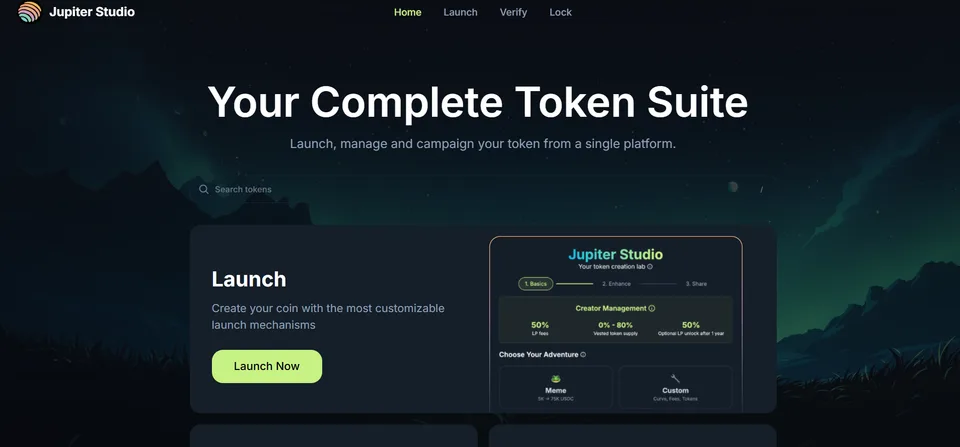
Jupiter Studio offers more control than Pump.fun while remaining within Solana's largest DEX aggregator ecosystem.
Features: LP fee configuration, optional LP locking, vested token settings, anti-sniper tools
Anti-sniping: Default 1% fee with optional anti-sniping that starts at 99% and decays over time
Graduation: Migrates to Meteora DAMMv2 pool
Pros: Jupiter ecosystem integration, more launch controls, better for serious projects
Cons: Less "feed velocity" than Pump.fun, more configuration required
Best for: Projects wanting launch control, anti-bot protection, Jupiter ecosystem alignment
BONK.fun — The Community Rival
A direct Pump.fun competitor leveraging the massive BONK community. Creator revenue was recently increased from 0.05% to 0.1%, making it attractive for creators.
Best for: Projects wanting to tap into the BONK ecosystem
Trade-off: Smaller overall audience than Pump.fun but more community-aligned
Bags — Creator-Focused
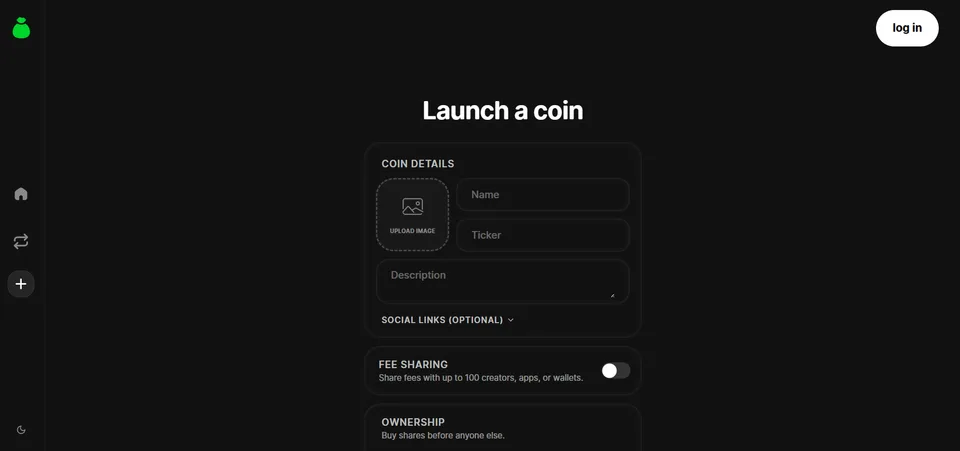
Bags emphasizes creator rewards and community launches. It offers better economics for token creators who want to build sustainable communities rather than pure speculation.
Best for: Creator-led projects, community tokens, social experiments
Raydium LaunchLab — DEX-Native Control
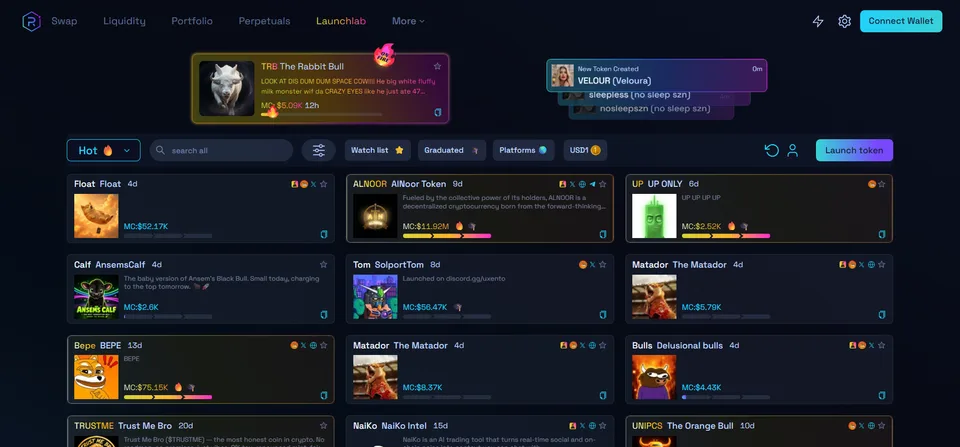
Raydium's own launch portal offering direct DEX integration and custom curve parameters. When Pump.fun migrated graduates to PumpSwap instead of Raydium, Raydium launched LaunchLab to recapture launch activity.
Advanced mode: Tweak curve behavior, control migration timing
Best for: Experienced creators wanting DEX-native control
Moonshot / Moon.it — The Social Launchpad
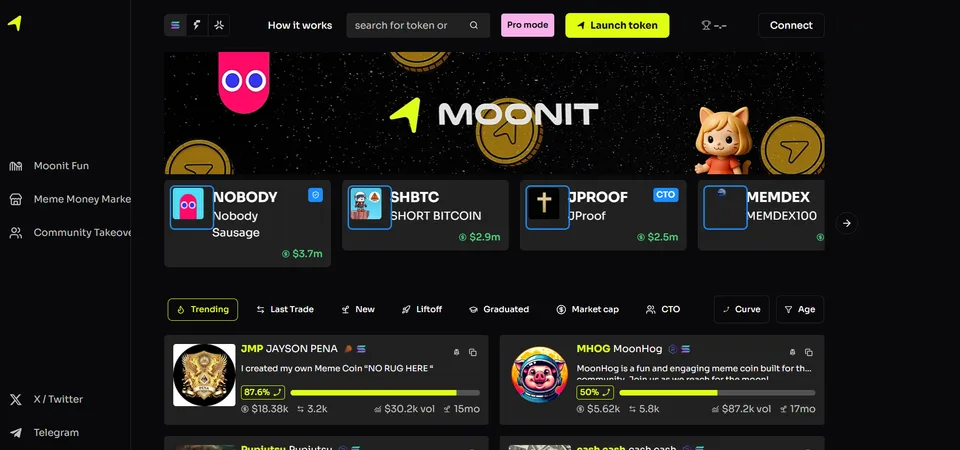
Previously Moonshot, now Moon.it from DexScreener. Unique mechanic: post a meme on 9GAG, and if the community upvotes it, the token launches automatically.
Best for: Social-first, meme-driven launches with built-in virality mechanics
Trade-off: Less control over launch timing, dependent on 9GAG community
Smithii — The Professional Suite
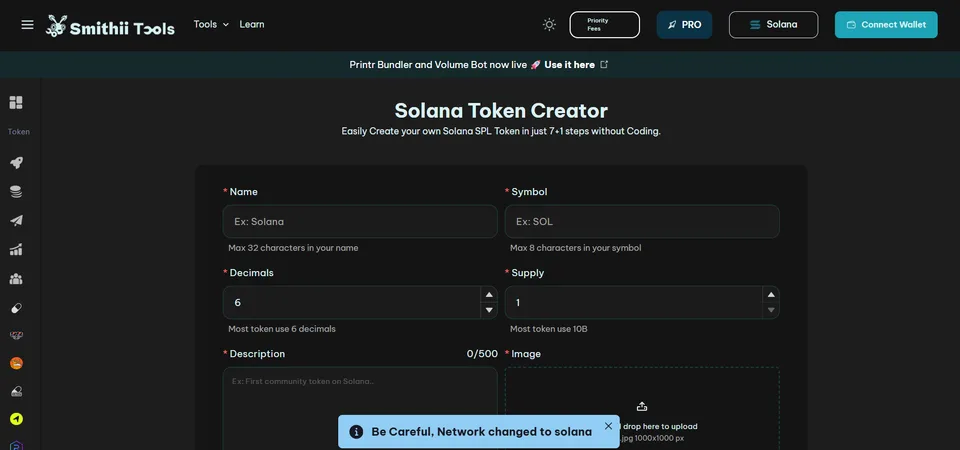
A comprehensive no-code platform supporting SPL and Token-2022 standards, with integrated liquidity pool creation, multi-chain support, and a CoinFabrik audit.
Cost: 0.3 SOL (~$45) basic; 0.6 SOL (~$90) with revoke features
Features: Authority management, IPFS integration, 24/7 support, volume bots
Best for: Serious projects needing credibility, advanced features, professional support
Solr Network — Budget-Friendly
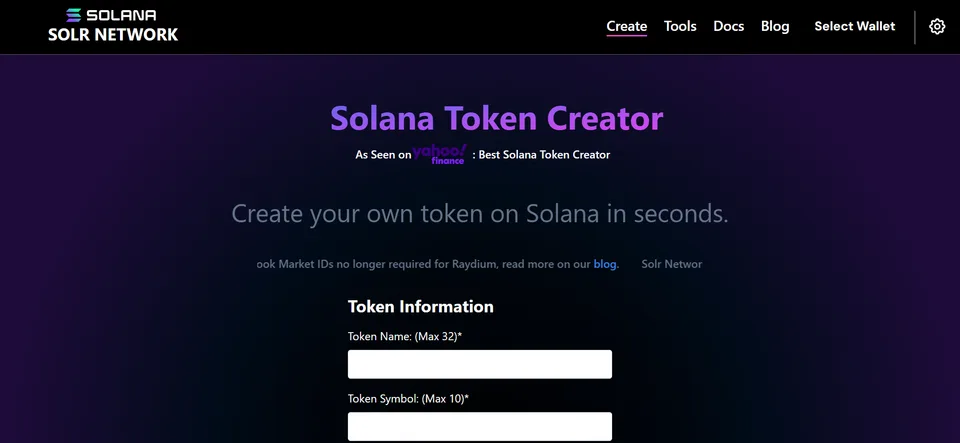
The lowest-cost option at 0.1 SOL (~$15), with essential features and Cloudflare IPFS integration.
Best for: Budget-conscious projects that still need core security features
How to Choose
Ask yourself:
Is this a meme coin or community experiment? → Pump.fun, BONK.fun, or Bags
Do I need anti-bot protection and launch controls? → Jupiter Studio or Raydium LaunchLab
Am I building a serious utility/DeFi token? → Smithii, custom SPL, or Jupiter Studio
Do I want social virality built into the launch? → Moon.it
Is budget my primary constraint? → Pump.fun (~$0.30) or Solr (~$15)
Chapter 4 — No-Code Token Creation: The Full Breakdown
For 90% of founders, no-code platforms are the right choice. Here's the step-by-step for the most common methods.
Launching on Pump.fun (The 5-Minute Method)
Step 1: Go to pump.fun and connect your wallet (Phantom, Solflare, or Backpack)
Step 2: Click "Create Coin"
Step 3: Fill in the fields:
Name: Your token name (check availability on socials first)
Ticker: 3-5 character symbol
Description: One compelling sentence + links
Image: Square, high-quality, memorable
Links: Website, Twitter/X, Telegram
Step 4: Click "Create Coin" and approve the transaction in your wallet (~0.002 SOL / ~$0.30)
Step 5: Your token is live on the bonding curve. Share the contract address immediately.
Critical notes:
The bonding curve means early buyers get the lowest prices
At ~$69,000 market cap, the token graduates to Raydium automatically
You cannot change the token parameters after creation
The 1.25% fee on the bonding curve is built into the platform
Launching on Jupiter Studio (The Controlled Method)
Step 1: Go to Jupiter Studio and connect your wallet
Step 2: Choose your launch mode:
Simple/Meme mode: Default settings, fast launch
Advanced mode: Configure LP fees, anti-sniping, vesting, liquidity locking
Step 3: Configure parameters:
Starting price and liquidity
LP fee tier (default 1%)
Anti-sniping settings (if enabled, starts at 99% fee decaying over time)
Vesting schedule for team tokens (optional)
Liquidity lock duration (optional but recommended)
Step 4: Deploy and approve transactions (~0.01–0.1 SOL / ~$1.50–$15)
Step 5: Monitor the launch dashboard for real-time metrics
Why choose this over Pump.fun:
Anti-sniping protects against bot front-running
Liquidity locking builds investor trust
Vesting shows long-term commitment
Jupiter ecosystem integration means better routing and discovery
Creating Liquidity Pools Post-Launch
If you didn't use a bonding curve launchpad, you'll need to create liquidity manually.
Raydium — The Standard Choice
Raydium is the dominant and most cost-effective DEX for new Solana tokens.
Standard AMM (CPMM): Best for new tokens. Cost: ~0.17 SOL (~$25) total. Supports Token-2022. No OpenBook market required.
Legacy AMM v4: Older, more expensive (~0.7 SOL+ / ~$105+ due to OpenBook market costs). Avoid for new launches.
Concentrated Liquidity (CLMM): Capital efficient but requires active management. Cost: ~0.1 SOL (~$15). Best for experienced traders, not standard launches.
Process:
Go to Raydium and connect your wallet
Select "Create Pool" → "Standard AMM"
Select your token + quote token (SOL or USDC recommended)
Set starting price and initial liquidity amount
Deploy (approve ~0.17 SOL / ~$25 in fees)
Orca — User-Friendly Alternative
Known for Whirlpools (concentrated liquidity). Has processed $160B+ in volume. Better UX for beginners but less launchpad integration than Raydium.
Meteora — Dynamic Liquidity
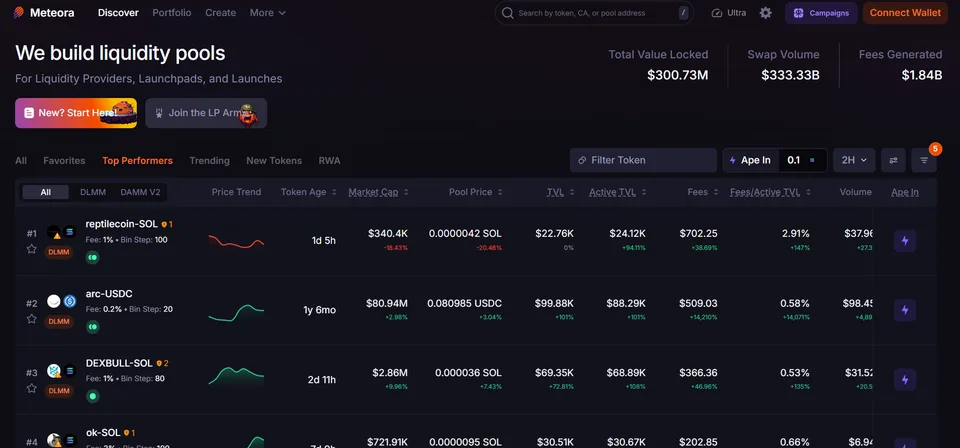
Features DLMM (Dynamic Liquidity Market Maker) pools that adjust fees based on volatility. Holds 15%+ of Solana DEX market share. Good for projects wanting dynamic fee adjustment.
Liquidity Best Practices:
Pair with SOL or USDC for maximum accessibility
Provide 20–40% of total supply to initial pool
Minimum $5,000–$10,000 for decent trading depth; serious projects start with $50,000+
Be aware of impermanent loss — monitor and adjust as needed
Chapter 5 — Developer Route: SPL & Token-2022
For projects needing custom functionality—staking, governance, DeFi integrations, or advanced tokenomics—you'll need to deploy custom contracts.
SPL Token (The Standard)
Solana's equivalent to ERC-20. Simple, universal, and supported by every wallet and DEX.
When to use SPL:
Standard fungible tokens
Meme coins, utility tokens, governance tokens
Any project that doesn't need transfer fees or advanced features
Deployment:
Use
spl-tokenCLI or Anchor frameworkCost: ~0.002 SOL (~$0.30) + rent-exempt minimum
Time: 1–2 hours for experienced developers; 1–2 days for beginners
Token-2022 (The Advanced Standard)
Solana's next-generation token standard with enhanced capabilities.
Key features:
Transfer fees: Charge fees on every transfer (like taxes on buys/sells)
Interest-bearing tokens: Tokens that accrue interest over time
Confidential transfers: Privacy-preserving transactions
Memo requirements: Mandatory memos on transfers
Non-transferable tokens: Soul-bound or credential tokens
When to use Token-2022:
Projects needing transfer fees (meme coins with tax mechanics)
DeFi protocols needing interest-bearing assets
Projects requiring compliance features (memo requirements)
RWA or credential tokens needing non-transferability
Trade-offs:
Not all DEXs fully support Token-2022 yet (Raydium Standard AMM does; check compatibility)
Slightly higher complexity
More configuration required at deployment
Custom Program Development
For DeFi protocols, games, or complex tokenomics, you'll write custom Rust programs using the Anchor framework.
Development stack:
Rust — Programming language for Solana programs
Anchor — Framework that simplifies Solana development
Solana CLI — Deployment and interaction tools
Phantom / Solflare — Testing and user interaction
Typical timeline:
Simple custom token: 1–3 days
Staking/governance contract: 1–2 weeks
DeFi protocol (lending, DEX): 1–3 months
Complex game economy: 2–6 months
Costs:
Developer rates: $50–$300/hour depending on experience
Audit: $3,000–$50,000+ depending on complexity
Deployment: Minimal (~0.002 SOL / ~$0.30; Solana's rent-exempt model)
Chapter 6 — Security on Solana: Locking, Audits & Anti-Bot
Solana's low fees make security affordable—but also make attacks cheap. In 2026, industrialized scam playbooks target new launches within seconds.
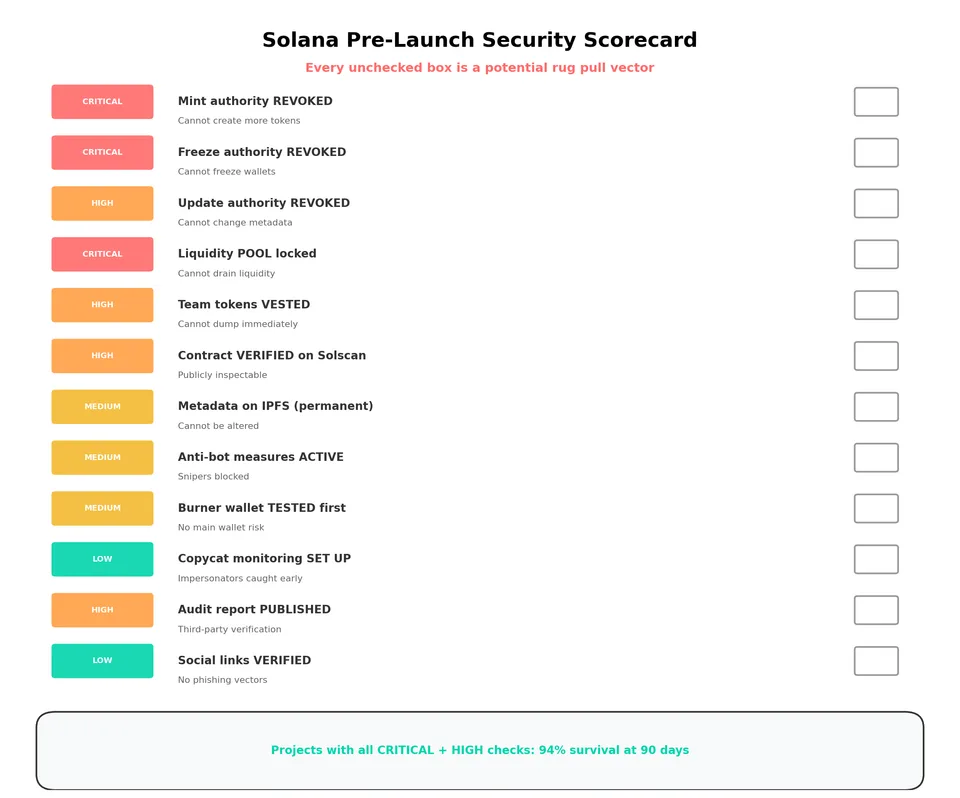
The Solana Security Checklist
Pre-Launch:
[ ] Contract verified on Solscan (or SolanaFM)
[ ] Mint authority revoked (for fixed-supply tokens)
[ ] Freeze authority revoked (unless needed for compliance)
[ ] Liquidity locked (use Jupiter Lock, Raydium locking, or third-party lockers)
[ ] Team tokens time-locked with vesting
[ ] Anti-bot measures configured (if using Jupiter Studio or custom deployment)
[ ] Metadata uploaded to IPFS (permanent, decentralized storage)
[ ] Burner wallet tested first
Post-Launch:
[ ] Monitor for copycat tokens (scammers create similar names within minutes)
[ ] Verify contract address is correct across all channels
[ ] Set up wallet monitoring for team/treasury wallets
[ ] Enable transaction alerts for unusual activity
Revoking Authorities (Critical for Meme Coins)
On Solana, token authorities control what can be changed after deployment:
Mint authority: Allows creating more tokens. Revoke this for fixed supply.
Freeze authority: Allows freezing wallets. Revoke for trustless tokens.
Update authority: Allows changing metadata. Consider revoking after finalizing.
How to revoke:
Use Smithii's revoke feature (0.6 SOL / ~$90 package)
Use Solana CLI:
spl-token authorize <token-address> mint --disableUse third-party tools like Solana Token Revoke
Why this matters: A token with active mint authority is a rug pull waiting to happen. Revoking authorities is the single most important trust signal on Solana.
Liquidity Locking
Locking your liquidity pool tokens proves you can't drain the pool.
Tools:
Jupiter Lock: Integrated with Jupiter Studio, transparent locking
Raydium Lock: Native to Raydium ecosystem
Third-party lockers: Various services offer time-locked LP tokens
Best practices:
Lock for minimum 6 months (1 year preferred)
Publish the lock transaction hash
Use verifiable, on-chain locking (not just a promise)
Anti-Bot Measures
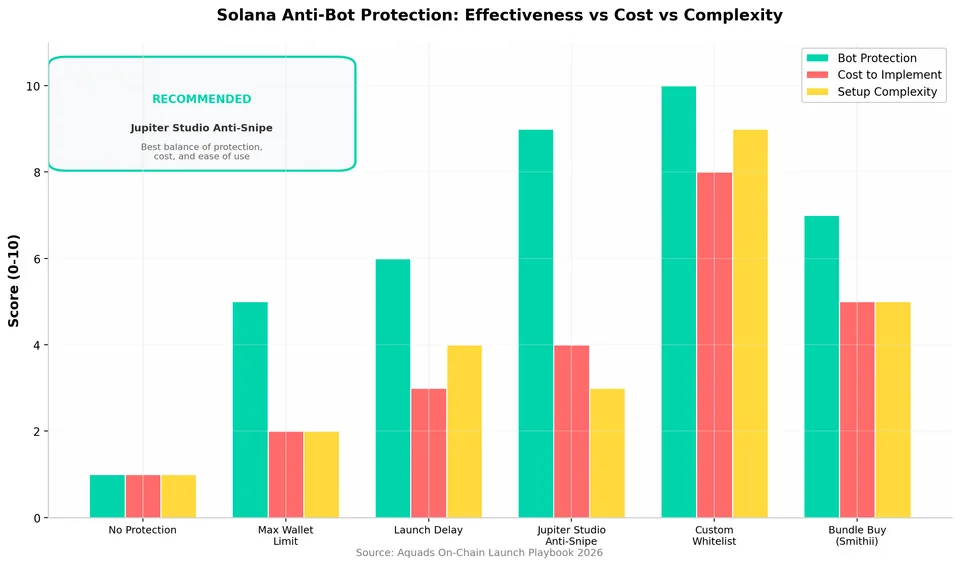
Solana's speed makes it a bot paradise. Without protection, sniper bots will buy your token at launch and dump on your community.
Jupiter Studio Anti-Sniping:
Starts with 99% swap fee at launch
Decays over time (e.g., to 1% over 24 hours)
Allows real community members to buy after bots have been priced out
Custom Anti-Bot (Advanced):
Max wallet limits per transaction
Launch delay (token created but trading disabled for X blocks)
Whitelist-only initial trading
Gradual liquidity addition (not all at once)
Volume Bots (Use Cautiously): Services like Smithii's Jupiter Volume Bot simulate trading to boost volume metrics and trending status. While effective for visibility, overuse can appear manipulative. Use sparingly and transparently.
Audit Costs on Solana
Audit Type | SOL Cost | USD Cost | Timeline | Best For |
|---|---|---|---|---|
Automated scan (MythX, Slither) | ~3–13 SOL | $500–$2,000 | 1–3 days | Simple tokens, initial checks |
Manual audit (CertiK, Hacken, OtterSec) | ~20–100 SOL | $3,000–$15,000 | 1–2 weeks | Most utility/governance tokens |
Comprehensive audit + remediation | ~100–333 SOL | $15,000–$50,000+ | 2–4 weeks | DeFi protocols, complex contracts |
For Pump.fun-style meme coins, a basic audit is often sufficient. For DeFi or custom programs, comprehensive audits are mandatory.
Chapter 7 — Marketing Your Solana Token
Solana's marketing playbook differs from other chains. The community is younger, more retail-focused, and moves faster.
The Solana Marketing Stack
1. Twitter / X (Essential)
Solana's community lives on X. This is your primary channel.
Post 5–10 times daily during launch week
Use threads to tell your story
Engage with Solana-native influencers and projects
Hashtags: #Solana #memecoin #SolanaNFT #Web3 #crypto
Pin your contract address + website + how to buy
Use visuals — memes, charts, and short videos perform best
2. Telegram (Essential)
Real-time community hub. Solana traders expect instant updates.
Create a group (not just a channel) for two-way conversation
Add moderation bots: Rose, Combot, Shieldy
Have 2–3 active moderators before launch
Welcome message with key links and FAQ
Voice chats for AMAs and launch parties
3. Discord (Recommended for Complex Projects)
Better for organized communities with multiple topics.
Announcements, general, price, memes, support channels
Roles for active members and OG holders
Voice channels for AMAs
4. DexScreener / Birdeye (Discovery)
These are where Solana traders discover new tokens.
Ensure your token is visible on both platforms immediately after liquidity creation
Update metadata, logo, and social links
Trending status drives organic discovery
5. TikTok / YouTube Shorts (Growing)
Short-form video is increasingly effective for reaching retail audiences.
Meme compilations, explainer clips, community highlights
Can drive viral discovery overnight
Solana-Specific Influencer Strategy
Micro-influencers (1K–20K followers): $50–$500 per post
High engagement rates
Niche Solana communities
Often accept token allocations instead of cash
Mid-tier (20K–100K): $500–$3,000 per post
Best ROI for most projects
Established Solana ecosystem presence
Can drive meaningful volume
Macro (100K+): $3,000–$20,000+ per post
Broad reach, lower engagement
Useful for major milestones (CEX listings, partnerships)
Solana-Native KOLs to Consider:
DeFi analysts and thread writers
NFT/community leaders with cross-pollination
Meme coin-focused accounts with proven track records
Pro tip: Many Solana influencers prefer token allocations or long-term partnerships over one-time payments. Structure deals with vesting to align incentives.
Volume and Trending Strategies
On Solana, visibility on DexScreener and Birdeye trending is critical.
Organic methods:
Coordinate community buying (shiller armies)
Time influencer posts to create volume spikes
Run trading competitions
Create FOMO through milestone celebrations
Tool-assisted (use transparently):
Volume bots (Smithii, etc.) can simulate trading activity
Bundled buys across multiple wallets at launch to prevent snipers and accelerate graduation
Caution: Overuse looks manipulative. Use as a visibility boost, not a sustained strategy.
Chapter 8 — Growing a Solana Community
Solana communities are distinct: fast-moving, meme-heavy, and skeptical of anything that feels corporate or inauthentic.
Solana Community Growth Tactics
1. Airdrops to Solana OGs
Target established Solana wallets:
Use snapshot tools to identify active wallets
Airdrop to holders of established Solana NFTs or tokens
Filter for wallet age, transaction history, and real activity
Avoid bot farms — Solana's low fees make Sybil attacks easy
2. Meme Contests
Solana communities are meme-native. Lean into it:
Weekly meme contests with token prizes
Feature winning memes on official channels
Create meme templates the community can remix
Reward creativity, not just volume
3. Shiller Armies / Raids
Organized community promotion:
Coordinate comments on influencer posts
Share in relevant Telegram and Discord groups
Engage in friendly "raids" on other communities
Critical: Must be authentic enthusiasm, not paid spam. Solana communities detect and reject artificial hype instantly.
4. Partnerships with Solana Projects
Cross-pollination with established Solana ecosystems:
NFT projects for airdrops or collaborations
DeFi protocols for liquidity incentives
Gaming projects for token utility
DAOs for governance participation
5. AMAs and Twitter Spaces
Regular voice sessions build trust:
Weekly or bi-weekly AMAs
Guest appearances on established Solana podcasts
Twitter Spaces with other Solana founders
Record and share highlights
Community Management Best Practices for Solana
Be present in real-time — Solana moves fast. Silence for 2 hours feels like abandonment.
Answer questions immediately — New holders often panic-buy and need reassurance
Ban spammers instantly — One spammer destroys the vibe in a 500-person Telegram
Celebrate Solana-specific milestones — DexScreener trending, Birdeye top 10, Raydium volume records
Use Solana-native language — "WAGMI," "gm," "ngmi," "diamond hands" — speak the culture
Be transparent about delays — Solana communities respect honesty over hype
Chapter 9 — Post-Launch: Listings, Volume, and Scaling
Immediate Post-Launch (Hours 1–24)
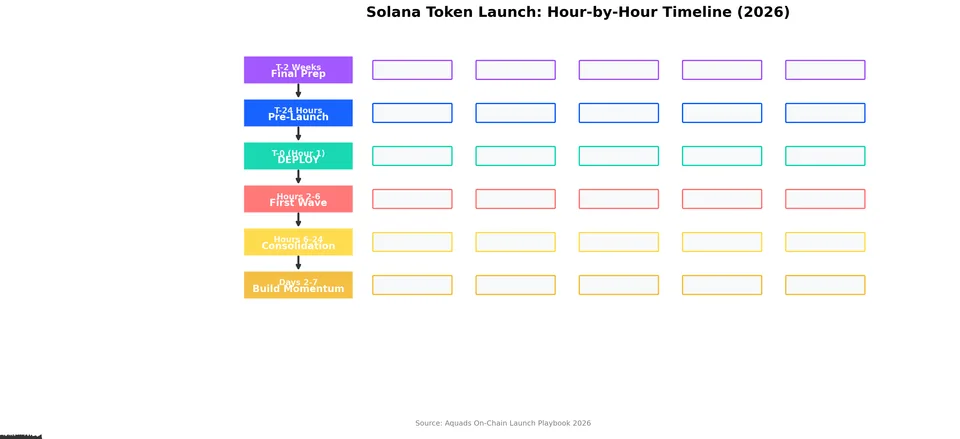
Hour 1:
Verify token appears on DexScreener and Birdeye
Check metadata, logo, and social links are correct
Monitor for copycat tokens and report them
Engage in Telegram/Twitter continuously
Hours 2–6:
Submit CoinGecko application (requires 2–3 days of trading volume first)
Submit CoinMarketCap application (requires more volume and time)
Continue marketing push
Monitor whale wallets and unusual activity
Hours 6–24:
Celebrate volume and holder milestones
Address all community questions
Fix any technical issues immediately
Begin planning Day 2 content
Week 1 Priorities
Daily content across all channels
Community events (meme contests, AMAs, giveaways)
Influencer follow-ups (additional posts, not just launch day)
Volume maintenance (organic community activity + strategic boosts)
DexScreener trending pursuit (requires sustained volume)
Month 1: Scaling
Exchange Listings:
Tier 3 CEXs (MEXC, Gate.io, Bitget, LBank): Apply after 1–2 weeks of strong volume. Cost: $1,000–$10,000 or free if volume is exceptional.
Tier 2 CEXs (KuCoin, Bybit, OKX): Requires $100K+ daily volume, active community, audit. Cost: $10,000–$50,000.
Tier 1 CEXs (Binance, Coinbase): Long-term goal for only the most successful projects.
Utility Expansion:
Staking programs (reward long-term holders)
NFT collections (extend brand into digital collectibles)
DeFi integrations (lending, borrowing, yield farming)
Gaming partnerships (if applicable)
Multi-Chain Expansion:
Consider bridging to Base or Ethereum for broader audience
Wormhole or LayerZero for cross-chain liquidity
Maintain Solana as primary chain
Chapter 10 — Real Costs: A Complete Budget Breakdown
All costs include both SOL and USD equivalents at ~$150/SOL (July 2026).
The Shoestring Launch ($5–$50)
Item | SOL Cost | USD Cost |
|---|---|---|
Wallet setup | Free | Free |
SOL for fees (0.5 SOL) | 0.5 SOL | ~$75 |
Pump.fun creation | ~0.002 SOL | ~$0.30 |
Basic design (Canva/DIY) | Free | Free |
Twitter/Telegram setup | Free | Free |
Organic marketing | Free | Free (your time) |
Total | ~0.5 SOL | ~$5–$50 (mostly SOL) |
What you get: A live token on Pump.fun with no liquidity lock, no audit, basic design, and organic growth only.
Survival rate: ~5% at 30 days without additional investment.
The Lean Launch ($500–$2,000)
Item | SOL Cost | USD Cost |
|---|---|---|
SOL for fees and liquidity | 1.5–3 SOL | ~$200–$500 |
Freelance design (logo, socials) | — | $100–$300 |
Liquidity pool creation (Raydium) | ~0.17 SOL | ~$25 |
Liquidity locking | Free–0.3 SOL | Free–$50 |
2–3 micro-influencers | — | $200–$500 |
Basic website (Carrd/Webflow) | — | $20–$50/year |
Smithii or Solr creation | 0.1–0.3 SOL | ~$15–$45 |
Telegram moderation bots | Free | Free |
Total | ~1.8–3.5 SOL | ~$500–$2,000 |
What you get: Professional appearance, locked liquidity, basic influencer push, functional website, and a fighting chance at graduation.
The Professional Launch ($5,000–$20,000)
Item | SOL Cost | USD Cost |
|---|---|---|
SOL for fees and liquidity ($5K–$20K) | 35–135 SOL | $5,000–$20,000 |
Professional branding (logo, guidelines, assets) | — | $500–$2,000 |
Website (custom Webflow/Nicepage) | — | $200–$500 |
Smart contract audit (if custom) | — | $3,000–$10,000 |
5–10 mid-tier influencers | — | $2,500–$10,000 |
Paid ads (Twitter, DexScreener) | — | $500–$2,000 |
Volume bot (initial boost) | — | $200–$500 |
Community management tools | — | $100–$300/month |
Legal review (optional but recommended) | — | $500–$2,000 |
Total | ~35–135 SOL | ~$5,000–$20,000 |
What you get: Full professional launch with audit, significant liquidity, multi-influencer campaign, paid amplification, and a real shot at sustained growth.
The Major Launch ($50,000+)
Item | SOL Cost | USD Cost |
|---|---|---|
Significant liquidity ($50K–$200K) | 335–1,335 SOL | $50,000–$200,000 |
Full agency branding and design | — | $5,000–$15,000 |
Comprehensive audit + remediation | — | $15,000–$50,000 |
10–20 influencers across platforms | — | $15,000–$50,000 |
Heavy paid amplification | — | $5,000–$20,000 |
Market maker services | — | $5,000–$20,000 |
CEX listing pursuit (Tier 2–3) | — | $10,000–$50,000 |
Ongoing community management | — | $3,000–$10,000/month |
Legal and compliance | — | $5,000–$20,000 |
Total | ~335–1,335 SOL | ~$50,000–$200,000+ |
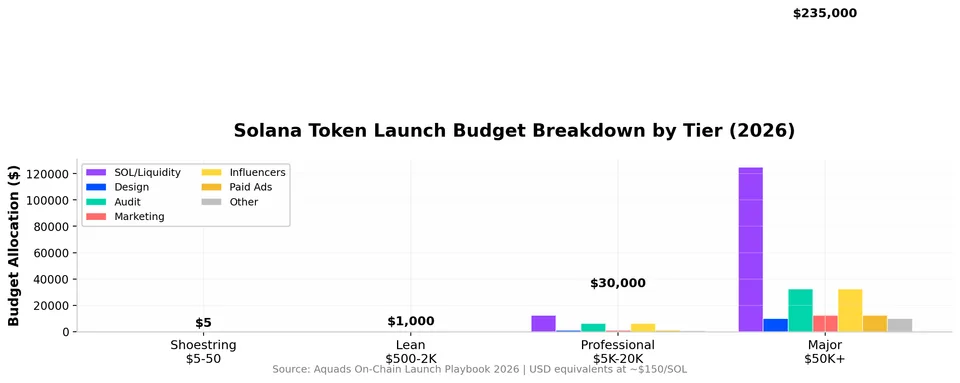
What you get: Institutional-grade launch with significant capital, comprehensive marketing, market making, exchange listings, and long-term operational support.
Chapter 11 — Common Solana-Specific Mistakes
1. Not Revoking Mint Authority The #1 trust killer. If you can still mint tokens, investors will assume you're planning to dump on them. Revoke it immediately after creation.
2. Ignoring Copycat Tokens Scammers create tokens with similar names within minutes of your launch. Monitor Solscan and DexScreener for impersonators and report them immediately.
3. Launching Without Liquidity A token without a liquidity pool is worthless. Even on Pump.fun, ensure you understand the graduation mechanism. On custom launches, create liquidity immediately.
4. Underestimating Bot Activity Solana's speed attracts sophisticated bots. Without anti-sniping or launch controls, bots will front-run your community and dump on them. Use Jupiter Studio's anti-sniping or custom protections.
5. Poor Metadata Tokens with broken images, missing descriptions, or incorrect social links look like scams. Upload metadata to IPFS (permanent storage) and verify it displays correctly on all platforms before announcing.
6. Launching Without a Community Solana is the most competitive launch environment in crypto. A token with zero social presence, zero followers, and zero momentum will be buried in the feed within minutes. Build community BEFORE launch.
7. Not Understanding the Bonding Curve On Pump.fun, the bonding curve means early buyers get the best prices. If you (the creator) buy too early, it looks like insider trading. If you buy too late, you pay more than your community. Time your participation carefully.
8. Neglecting Mobile Users Over 60% of Solana activity happens on mobile. Your website, social content, and buying guides must work perfectly on phones. Phantom's mobile app is the primary wallet for most retail users.
9. Failing to Graduate (Pump.fun) Most Pump.fun tokens never reach the $69,000 market cap needed to graduate to Raydium. Without graduation, the token is trapped in the bonding curve with limited liquidity. Plan your launch to drive sufficient volume.
10. Overusing Volume Bots Volume bots can boost visibility but overuse creates artificial-looking charts that scare away real investors. Use them as a launch-day boost, not a sustained strategy. Be transparent with your community if you use them.
Chapter 12 — Frequently Asked Questions
How much SOL do I need to launch a token?
Minimum: 0.5 SOL (~$75) for fees and basic interaction. Recommended: 2–5 SOL (~$300–$750) for creation, liquidity, and marketing. Professional: 20–50+ SOL (~$3,000–$7,500) for significant liquidity and paid marketing.
Can I launch a token on Solana for free?
Technically yes — Pump.fun charges only network gas (~0.002 SOL / ~$0.30). But a "free" launch without liquidity, marketing, or community will almost certainly fail. Budget at least $100–$500 for a viable attempt.
What's the difference between SPL and Token-2022?
SPL is the standard fungible token (like ERC-20). Simple, universal, supported everywhere. Cost: ~0.002 SOL (~$0.30). Token-2022 adds advanced features: transfer fees, interest-bearing, confidential transfers, and more. Cost: ~0.002–0.3 SOL (~$0.30–$45). Use SPL for most projects. Use Token-2022 if you need specific advanced features.
How do I get my token on DexScreener?
DexScreener automatically lists most Solana DEX tokens once liquidity is created on Raydium, Orca, or Meteora. Ensure your token has:
Active trading volume
Correct metadata (logo, name, social links)
Verified contract on Solscan
Update your metadata through the DexScreener token page if needed.
How do I get listed on CoinGecko / CoinMarketCap?
CoinGecko: Submit via their request form after 2–3 days of active trading. Requires functional website, verified contract, and active social presence. Timeline: 2–6 weeks.
CoinMarketCap: Requires more volume and a longer track record. Submit via their online form only. Timeline: 2–4 weeks after complete submission.
What is "graduation" on Pump.fun?
When a token's market cap reaches ~$69,000 on Pump.fun, it automatically migrates from the bonding curve to a Raydium liquidity pool. This makes the token tradable on all Solana DEXs via Jupiter routing. Graduation is a critical milestone — without it, the token has limited liquidity and accessibility.
Should I use a volume bot?
Volume bots can help with initial visibility and trending status, but they are controversial. Use them sparingly as a launch-day boost, not a sustained strategy. Be transparent with your community. Organic volume from real community activity is always more valuable long-term.
How do I protect against sniper bots?
Best options:
Use Jupiter Studio's anti-sniping (99% fee decaying over time)
Set max wallet limits per transaction
Use a launch delay (token created but trading disabled initially)
Coordinate a bundled community buy at launch
Use Smithii's bundler tool to execute multiple wallet buys simultaneously
Can I launch a utility token or DeFi protocol on Solana?
Absolutely. Solana's speed and low costs make it excellent for DeFi and utility tokens. Use Jupiter Studio or custom SPL/Token-2022 deployment for more control. The Jupiter, Raydium, Orca, and Meteora ecosystems provide deep liquidity infrastructure. For complex DeFi, budget for custom development and comprehensive audits.
What wallet should I use?
Phantom is the most popular and user-friendly. Solflare has stronger DeFi integrations. Backpack is exchange-integrated and growing fast. All three are secure and widely supported. Choose based on your personal preference and which UI you prefer.
Conclusion
Solana offers the fastest, cheapest, and most competitive environment for launching tokens in 2026. The technical barriers are lower than ever — you can create a token in 5 minutes for less than a dollar. But the competition is fiercer than ever, and the projects that win are those that combine technical execution with exceptional branding, community building, and marketing.
Whether you're launching a meme coin on Pump.fun, a utility token with custom SPL contracts, or a DeFi protocol integrated with Jupiter, the principles remain the same: build community first, operate transparently, secure your contracts, and never stop marketing.
For the foundational strategies that apply to every chain — project vision, legal considerations, tokenomics design, and universal launch frameworks — refer to the Complete Playbook for Launching On-Chain Projects in 2026.
Good luck. Build something the Solana community will remember.
This guide is part of the Aquads On-Chain Launch Playbook series. For tools, resources, and services to help launch and grow your Solana project, visit aquads.xyz.
Sources & Further Reading:
CoinBureau — Best Memecoin Launchpads in 2026 (July 2026)
CryptoSlate — Best Solana Launchpads 2026 (May 2026)
Backpack Learn — How to Create a Solana Token in 2026 (March 2026)
Backpack Learn — How to Launch a Meme Coin on Solana: Complete 2026 Guide (March 2026)
Smithii — How to Create a Meme Coin on Solana: Updated 2025 Guide (June 2026)
Smithii — The Ultimate Guide for Devs on Solana [2026] [No-Code] (June 2026)
Disence — Token Launch Cost in 2026: What to Expect Today (June 2026)
7BlockLabs — How Much Will It Cost to Deploy a Smart Contract in 2026? (December 2025)
Solana Documentation — SPL Token & Token-2022 Standards
Jupiter Studio Documentation
Raydium Documentation — Pool Creation & LaunchLab